Lion's Mane Capsules: What to Check Before You Buy

Introduction
Lions mane capsules look almost identical on the shelf, yet what sits inside them can differ a great deal. Some contain a concentrated fruiting body extract, others hold mycelium grown on grain, and many never say which. This guide walks through the checks that matter before you buy: the source of the mushroom, the extract ratio, beta-glucan content, fillers, serving size and independent testing. It also covers how capsules are regulated in Australia, plus a short note for brands planning their own Lion's Mane range.
What Should You Check Before Buying Lion's Mane Capsules?
Before buying Lion's Mane capsules, check five things: the part of the mushroom used, the extract ratio, the stated beta-glucan content, the full ingredient list and whether recent lab results are available. Everything else on the bottle is mostly marketing.
The label is your best tool. A brand that is confident in its product tends to state exactly what is in each capsule, how it was made and how it was tested. Vague wording such as "full spectrum blend" or "mushroom complex" without numbers usually means the details are not flattering.
| Check | What good looks like | Red flag |
|---|---|---|
| Mushroom part | "Fruiting body" stated clearly | "Mycelium", "myceliated grain" or no part listed |
| Extract ratio | A stated ratio, such as 10:1, with the method | No ratio, or a ratio with no explanation |
| Beta-glucans | Measured beta-glucans, ideally from a named lab | Only "polysaccharides", which can include starch |
| Ingredients | Extract plus capsule shell, little else | Rice flour, fillers or undisclosed blends |
| Testing | Recent certificate of analysis on request or online | No results available |
Fruiting Body or Mycelium: Why the Source Matters

The fruiting body is the visible mushroom, and it is the part traditionally eaten and most often studied, so it is the clearest choice for capsules. Mycelium is the root-like network that grows inside a substrate.
Mycelium products are often grown on grain, such as oats or brown rice, and the grain is frequently harvested along with the mycelium. That means a portion of the capsule can be starch rather than mushroom. It is not unsafe, but you get less Lion's Mane per capsule than the label weight suggests.
Our capsules contain 100% Lion's Mane (Hericium erinaceus) fruiting body extract, with no mycelium, grain, starch or fillers. The mushrooms are grown in Thomastown, Victoria, on Tasmanian oak hardwood sawdust and Australian soya husk. You can see the full process on our farm and process page.
Extract Ratio and Beta-Glucans: Reading the Numbers
An extract ratio tells you how much fresh or dried mushroom went into the finished powder, while beta-glucan content tells you how much of a key compound is actually present. Both numbers matter, and neither tells the whole story alone.
A 10:1 ratio means roughly ten parts of raw material were concentrated into one part of extract. Ours is freeze-dried at minus 82 °C, then put through a hot-water and ethanol dual extraction to make a 10:1 fruiting body extract. Our article on what a 10:1 fruiting body label means explains the maths.
Beta-glucans are the polysaccharides Lion's Mane is often researched for. Look for "beta-glucans" specifically, because a generic "polysaccharides" figure can include starch from grain. Our Symbio Laboratories certificate (S2162602 [R01], 13 May 2026) recorded 32.2% beta-glucans in the tested extract powder blend with 1% BioPerine, a sample-specific result rather than a guarantee for every finished product, and an earlier AEGIC sample (November 2024) recorded 24.5 g/100 g. Results apply to the samples tested.
Fillers, Capsule Shells and Serving Size
The best Lion's Mane capsules contain the extract and the capsule shell, with few or no added fillers. Read the full ingredient list, not just the front panel.
Common additions include rice flour, maltodextrin and flow agents. Some are used for manufacturing convenience, but they take up space that could hold mushroom extract. Also check whether the shell suits your diet. Our capsules are vegan, gluten free and non-GMO.
Serving size is the other number to compare. Our label serving is 2 x 300 mg capsules, available in bottles of 60 and 120. When comparing products, work out the extract per serve rather than the capsule count, because a large bottle of low-strength capsules can cost more per useful gram. Always follow the directions on the label, and speak with your GP or pharmacist if you take medication or have a health condition. Our guide is Lion's Mane safe covers what research does and does not show.
Testing and Lab Results: What a Credible Brand Shows You

A credible capsule brand can show recent results from an independent laboratory, and will tell you which tests have and have not been done. Honesty about gaps is as useful as the results themselves.
Useful tests include beta-glucan content, heavy metals and microbial testing, such as E. coli and coliforms. Ours include the Symbio Laboratories certificate S2162602, AEGIC testing for beta-glucans, heavy metals and nutrition, NMI protein testing on whole mushroom powder (16.7 g/100 g), and microbial testing by RMIT University researchers (April 2025) where E. coli and coliforms were not detected. Pesticide testing has not been done yet, and we say so openly.
All of this sits on our specifications and testing page. If a brand cannot point you to something similar, treat its claims with caution.
How Are Lion's Mane Capsules Regulated in Australia?
Lion's Mane is legal to buy in Australia, but how a product is regulated depends on how it is presented and what it claims. The Therapeutic Goods Administration updated its guidance in October 2024, treating Lion's Mane as a novel food and noting that extracts sold with dosage instructions or therapeutic claims are likely to be therapeutic goods.
For shoppers, the takeaway is simple: be wary of capsules promising to treat or cure anything.
Selling Lion's Mane Capsules Under Your Own Brand?
If you run a supplement brand, cafe or wellness store, the same checklist applies to your supplier. Ask for the fruiting body source, extract method, ratio and recent certificates before you commit, and get regulatory advice on how your capsules will be presented. Xotic supplies white label Lion's Mane extract in 1 kg and 5 kg bulk, with the testing documents above available for your due diligence.
Conclusion
Good lions mane capsules are easy to spot once you know what to read: fruiting body source, a clear extract ratio, measured beta-glucans, a short ingredient list and real lab results. If ours tick your boxes, see our Lion's Mane capsules. Brands can ask about white label supply.
FAQs
Are fruiting body Lion's Mane capsules better than mycelium?
Fruiting body capsules contain the part of the mushroom traditionally eaten and most often studied. Mycelium products are often grown on grain, so part of each capsule can be starch rather than mushroom. Neither is inherently unsafe, but a fruiting body extract gives you a clearer picture of how much Lion's Mane you are actually taking per serve.
What does 10:1 mean on Lion's Mane capsules?
A 10:1 ratio means about ten parts of mushroom were concentrated into one part of extract. Xotic Mushrooms fruiting bodies are harvested, freeze-dried and processed into a 10:1 extract. The ratio shows concentration, but it should be read alongside a measured beta-glucan figure from an independent laboratory.
How many Lion's Mane capsules should I take?
Follow the serving size on the label of the product you buy. The Xotic Mushrooms label serving is two 300 mg capsules. We do not give individual dosage advice, so if you are pregnant, breastfeeding, taking medication or managing a health condition, speak with your GP or pharmacist before starting any Lion's Mane supplement.
Is it okay to take Lion's Mane capsules daily?
Many people take Lion's Mane as part of a daily routine, following the label serving. Human research is still limited, especially for long-term use, so it is sensible to check with your GP or pharmacist first, particularly if you take medication, have a mushroom allergy, or are pregnant or breastfeeding.
Are Lion's Mane capsules legal in Australia?
Yes, Lion's Mane products can be legally sold in Australia. The TGA's October 2024 guidance treats Lion's Mane as a novel food, and extracts presented with dosage instructions or therapeutic claims are likely to be regulated as therapeutic goods. How a product is labelled and marketed determines which rules apply to it.
Should Lion's Mane capsules have a certificate of analysis?
A reputable brand should be able to share a recent certificate of analysis from an independent laboratory. Look for beta-glucan content, heavy metals and microbial results, and note which tests have not yet been done. Remember that each certificate applies to the specific sample tested, not every future batch.
Source Lion’s Mane extract powder at scale
Australian-grown 10:1 fruiting body extract in 1 kg and 5 kg bags, with named-lab testing and white label supply for growing brands.
Request a sample or quote
Related articles
 7 October 2026
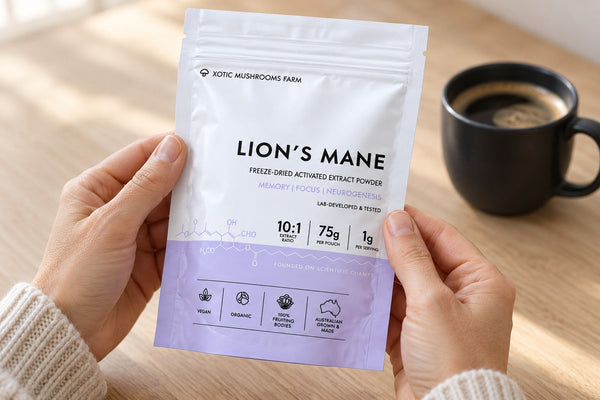
Best Mushroom Coffee in Australia: What to Look For on the LabelLooking for the best mushroom coffee in Australia? Use this label checklist to compare mushroom type, extract ratio,...
7 October 2026
Best Mushroom Coffee in Australia: What to Look For on the LabelLooking for the best mushroom coffee in Australia? Use this label checklist to compare mushroom type, extract ratio,...
 7 October 2026
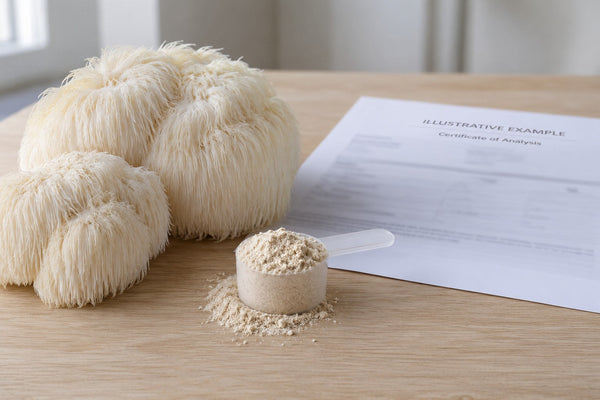
Mushroom Extract in Australia: What Buyers Should CheckBuying mushroom extract in Australia? Learn how to check the extract ratio, fruiting body source, beta-glucans, extraction method,...
7 October 2026
Mushroom Extract in Australia: What Buyers Should CheckBuying mushroom extract in Australia? Learn how to check the extract ratio, fruiting body source, beta-glucans, extraction method,...
 7 October 2026
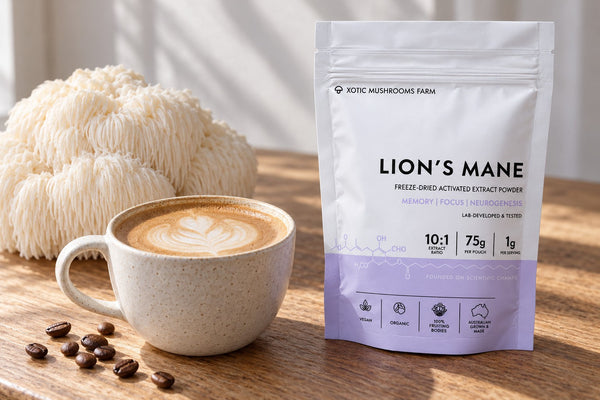
Mushroom Coffee in Australia: What It Is and How to ChooseA clear guide to mushroom coffee in Australia: what it is, which mushrooms are used, what to check...
7 October 2026
Mushroom Coffee in Australia: What It Is and How to ChooseA clear guide to mushroom coffee in Australia: what it is, which mushrooms are used, what to check...
Get farm and supply updates
New batches, lab results and bulk pricing, a few times a year.