
Symbio Laboratories
Sydney. Certificate of Analysis S2162602 [R01] for a submitted fruiting body freeze-dried extract powder blend with 1% black pepper extract (BioPerine): beta-glucans and nine trace elements.
Open the COA (PDF) ↗Specs & Lab Analysis
The specification for our Lion’s Mane extract powder and capsules, every lab result we hold, and the research behind it. Each result names the lab, the sample and the date.

No starch, mycelium, grain or fillers.
In a tested extract blend with 1% BioPerine. Symbio Laboratories, May 2026.
CFU/mL detected in RMIT researchers’ April 2025 screening.
Symbio, AEGIC, the National Measurement Institute and RMIT researchers.
| Parameter | Value | Method / source |
|---|---|---|
| Ingredient | 100% Lion’s Mane fruiting body extract. No starch, mycelium, grain or other fillers | Spec sheet; Symbio COA S2162602 |
| Botanical name | Hericium erinaceus | Spec sheet |
| Part used | Fruiting body only | Spec sheet |
| Extraction method | Freeze-dried at −82 °C, hot-water + ethanol dual extraction | Spec sheet (our production process) |
| Extraction ratio | 10:1 (about 4 kg fresh Lion’s Mane per 100 g) | Spec sheet (production records) |
| Beta-glucans | 32.2 g/100 g in a tested blend with 1% BioPerine (Symbio, May 2026); 24.5 g/100 g in a historical sample (AEGIC, Nov 2024) | Symbio COA S2162602 (May 2026); AEGIC report 16896 (Nov 2024) |
| Growing substrate | Tasmanian oak hardwood sawdust and Australian soya husk (Master’s Mix) | Farm growing records |
| Dietary | Vegan, gluten free, non-GMO | Spec sheet |
| Heavy metals | 9 trace elements analysed by Symbio (May 2026) and AEGIC (Nov 2024) | Symbio COA S2162602; AEGIC report 16896 |
| Microbial | E. coli and coliforms not detected (0 CFU/mL) | RMIT University researchers, Apr 2025 |
| Country of origin | Australia (grown in Thomastown, Victoria) | Our farm, Thomastown VIC |
| Serving | Powder: 1 g (75 servings per 75 g pouch). Capsules: 2 × 300 mg | Product labels |
| Pack sizes | Powder: 50 g, 75 g, 150 g, 300 g and 1.2 kg retail; 1 kg and 5 kg bulk. Capsules: 60 and 120 (300 mg each) | Product labels |
Mushroom powder is dried and ground. Extract powder goes through an extraction step first.
A ratio such as 10:1 says how much raw material went in. It does not measure the compounds in the result.
Beta-glucans are one group within total polysaccharides. They are tested and reported separately, and results depend on the test method.
Who tests it
Sydney. Certificate of Analysis S2162602 [R01] for a submitted fruiting body freeze-dried extract powder blend with 1% black pepper extract (BioPerine): beta-glucans and nine trace elements.
Open the COA (PDF) ↗North Ryde, NSW. Analysed our fruiting body extract powder for beta-glucans (yeast & mushroom method), nine heavy metals and a nutrition profile. Report 16896 available on request.
Protein, amino acids and vitamin D2 in a submitted freeze-dried whole mushroom powder (report RN1433164). This covers mushroom powder, not the extract.
Researchers led by Dr Tien Huynh work with us on microbial screening, compound profiling, microscopy and hericenone reference standards, under a research agreement.
Results
Results apply to the sample and date shown, not to every batch.
| Test | Laboratory | Date | Result |
|---|---|---|---|
| Beta-glucans (Mushroom and Yeast method) | Symbio Laboratories | May 2026 | 32.2 g/100 g in a tested extract blend with 1% BioPerine. COA |
| Trace elements (9) | Symbio Laboratories | May 2026 | Values and reporting limits in the COA |
| Beta-glucans (yeast & mushroom method) | AEGIC | Nov 2024 | 24.5 g/100 g in a historical sample (method B7, outside the lab’s NATA scope). Report on request |
| Heavy metals (9 trace elements) | AEGIC | Nov 2024 | Report on file, available on request |
| Nutrition profile | AEGIC | Nov 2024 | Report on file, available on request |
| Protein, amino acids, vitamin D2 | National Measurement Institute | Jul 2024 | Whole mushroom powder: protein 16.7 g/100 g; vitamin D2 <0.5 µg/100 g |
| E. coli and coliforms | RMIT University researchers | Apr 2025 | Not detected (0 CFU/mL) |
| Particle size (70, 200, 300 micron) | Independent laboratory | Jan 2026 | Completed |
| Pesticides | — | — | Not yet tested |
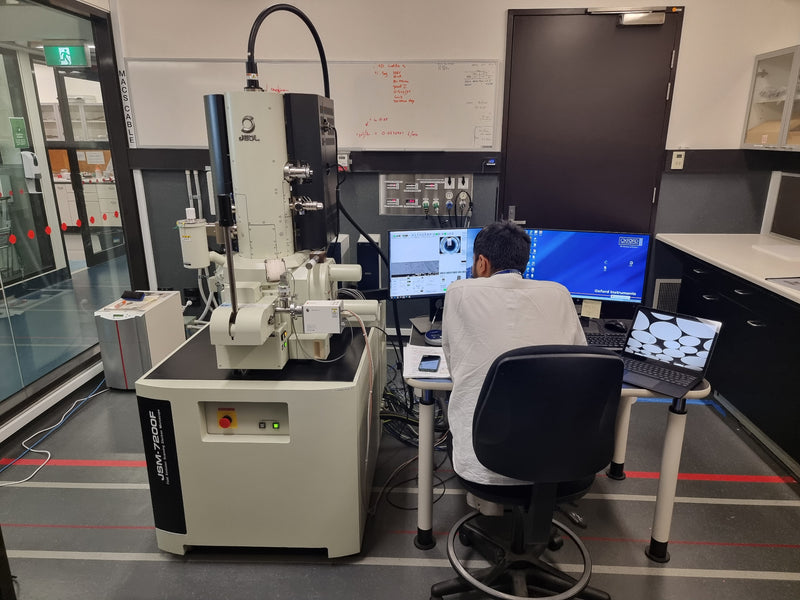
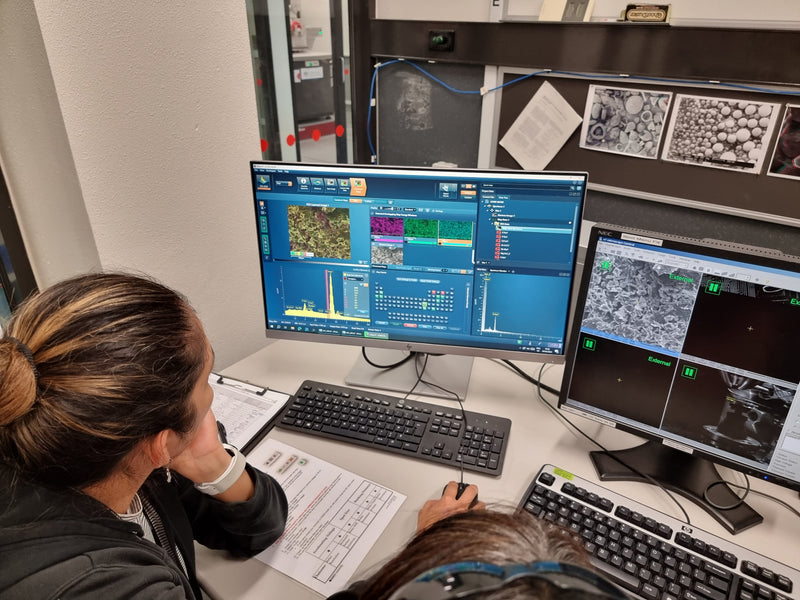
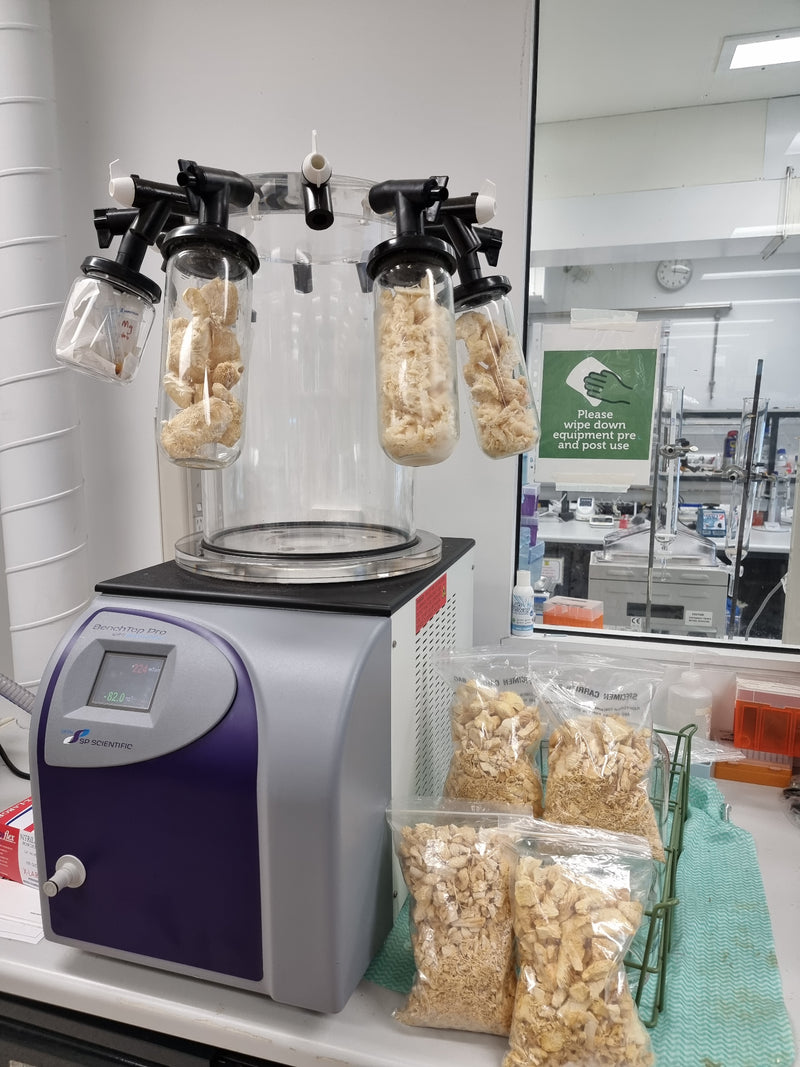
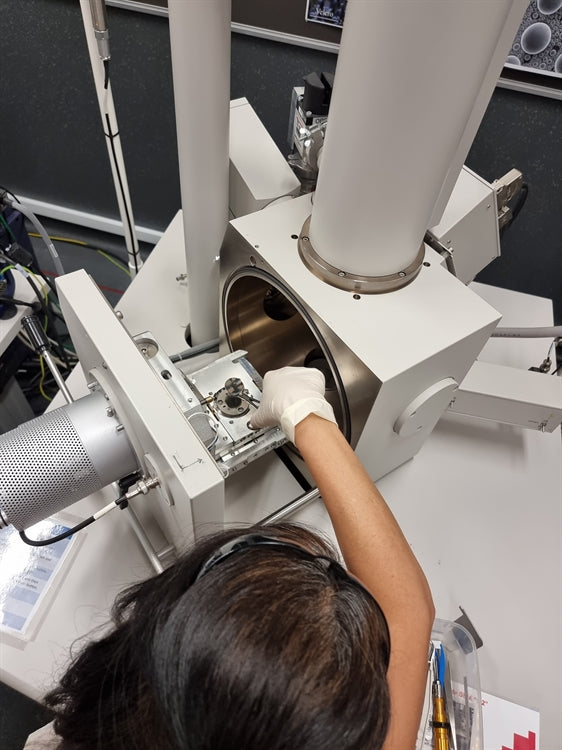
Inside the lab
Fresh Lion’s Mane is freeze-dried at −82 °C, then extracted. With RMIT University researchers we have examined it under scanning electron microscopy and profiled its compounds by MALDI mass spectrometry, alongside the independent tests above.
Testing history
A plain record of what has been done so far, and what is still underway.
| Date | What | Who | Status |
|---|---|---|---|
| Feb 2024 | Compound profiling (MALDI mass spectrometry) | RMIT University researchers | Completed |
| Jul 2024 | Protein, amino acids, vitamin D2 | National Measurement Institute | Report issued |
| Nov 2024 | Beta-glucans, heavy metals, nutrition | AEGIC Analytical Services | Report issued |
| Apr 2025 | E. coli and coliform screening | RMIT University researchers | Not detected |
| Dec 2025 | Peer-reviewed food science study using our Lion’s Mane, Foods 14(23), 4153 | Gunathilake and colleagues | Published |
| Jan 2026 | Particle size analysis (70, 200, 300 micron) | Independent laboratory | Completed |
| May 2026 | Beta-glucans and nine trace elements (COA S2162602) | Symbio Laboratories | Report issued |
| 2026 | Hericenone reference standards | RMIT University (research agreement) | In progress |

Published research
A peer-reviewed study in Foods (Gunathilake and colleagues, 2025) names Xotic’s Melbourne farm as the source of its fresh Lion’s Mane, which was freeze-dried, milled and studied in oat-based desserts. Read the paper → It is food science research, not a clinical trial or a claim about what our products do.
Hericenone reference standards are being developed with RMIT under a research agreement. Once they exist, measured hericenone content can be reported.
What’s next
A certificate of analysis for each production batch.
At an accredited laboratory that offers pesticide panels.
Once RMIT’s reference standards are ready.
Not yet. The results above are for the sample and date shown. Per-batch certificates are the next step.
The Symbio COA is linked above. Business buyers can request copies of the other reports with a sample.
Symbio Laboratories reported 32.2 g/100 g for a submitted fruiting body freeze-dried extract powder blend with 1% black pepper extract (BioPerine), certificate S2162602 [R01], 13 May 2026. It applies to that blend, not to every batch.
How much raw mushroom went into the extract, not how strong it is. About 4 kg of fresh Lion’s Mane goes into every 100 g of our powder.
Download the specification sheet, or request the full lab reports and a sample.