Lion's Mane Formats Compared: Powder, Capsules, Liquid and Gummies

Introduction
A Lion's Mane supplement now comes in almost every format you can think of: loose powder, capsules, liquid drops and gummies. Each one changes how much Lion's Mane you actually get, what else comes with it, what it costs per serve and how easy it is to take every day. This guide compares all four fairly, including the two formats we do not make, so you can pick the one that suits your routine. It finishes with a section for brands choosing a format to launch.
Which Lion's Mane supplement format is best?
For most people, powder offers the most flexibility and value, while capsules offer the most convenience; liquids and gummies trade some control over dose and ingredients for ease. The best format is the one you will take consistently, made from a well-documented extract.
| Format | Best for | Strengths | Watch for |
|---|---|---|---|
| Powder | Coffee and smoothie drinkers | Flexible serve, usually lowest cost per serve, no capsule shell | Earthy taste, needs measuring |
| Capsules | Busy routines and travel | Measured, tasteless, portable | Fixed dose per capsule, shell ingredients |
| Liquid | People who dislike swallowing pills | Quick to take, mixes into water | Alcohol or glycerine base, strength per ml varies |
| Gummies | Taste-first users | Pleasant, easy habit | Added sugars or sweeteners, smaller active amount |
Xotic Mushrooms makes powder and capsules from the same Lion's Mane extract, so we have no reason to downplay the other formats. Where liquids and gummies suit someone better, they are worth considering.
What matters more than format
The quality of the Lion's Mane inside matters more than the format it comes in. A capsule of weak, grain-heavy mycelium is a poorer buy than a powder of well-tested fruiting body extract, and the reverse is also true.
Before comparing formats, check three things. First, the part used: the fruiting body is the mushroom itself, while mycelium grown on grain can carry starch into the finished product. Second, the extract ratio and method, for example a 10:1 hot-water and ethanol dual extraction. Third, testing: a dated certificate of analysis from a named laboratory.
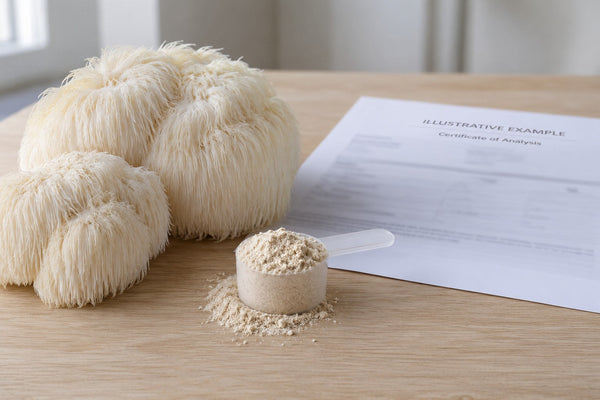
Our Lion's Mane (Hericium erinaceus) is grown in Thomastown, Victoria, on Tasmanian oak hardwood sawdust and Australian soya husk. The fruiting bodies are harvested, freeze-dried at minus 82 °C and processed into a 10:1 extract. If you are new to the ingredient, our explainer on what Lion's Mane extract is covers the basics, and our functional mushrooms guide puts it alongside other species.
Lion's Mane is often researched for its role in cognitive wellbeing and is commonly associated with focus routines. Research, including work on compounds called hericenones and erinacines, is still developing, so no format can promise a particular result.
Lion's Mane powder

Powder is the most flexible Lion's Mane format, letting you stir a measured serve into drinks or food. It is usually the best value per serve because there is no capsule shell, encapsulation step or added sweetener.
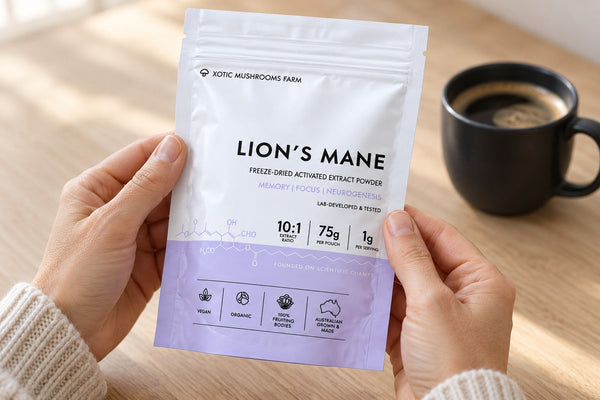
Our Lion's Mane extract powder has a label serve of 1 g, which gives 75 serves in a 75 g pouch. It comes in 50 g, 75 g, 150 g, 300 g and 1.2 kg sizes, so regular users can buy larger packs. It mixes well into coffee, cacao, smoothies and porridge, and our guide on how to use Lion's Mane extract powder has simple ideas.
The trade-offs are taste and effort. Extract powder has a mild, earthy flavour that is easy to hide in coffee but noticeable in plain water. You also need to measure it, which is quick once it becomes a habit.
Powder suits people who already have a daily drink ritual, who like to adjust their routine, or who want the lowest cost per serve.
Lion's Mane capsules
Capsules are the most convenient Lion's Mane format: measured, tasteless and easy to carry. They suit people who want a supplement that takes seconds and fits a morning routine.
Our Lion's Mane capsules contain 300 mg of the same fruiting body extract, with a label serve of 2 capsules. They come in bottles of 60 and 120.
The main limit is flexibility. Each capsule holds a fixed amount, so changing your serve means changing the number of capsules. Capsules also cost more to produce than loose powder, which is usually reflected in the cost per serve.
Check the capsule shell too. Some are gelatine, others plant based, and some products add flow agents to help the machinery fill them. A short ingredient list is a good sign.
Liquid Lion's Mane extracts

Liquid Lion's Mane extracts, often called tinctures, are quick to take and suit people who prefer not to swallow capsules. They are usually made with alcohol, water or vegetable glycerine as the base.
Liquids can be convenient, but they are harder to compare. Strength is often expressed per millilitre or as a herb to liquid ratio, which does not line up neatly with the extract ratio on a powder. Ask how much dried Lion's Mane is in each serve and whether the starting material was fruiting body.
Alcohol-based tinctures may not suit everyone, and glycerine-based versions can taste sweet. Once opened, follow the storage directions on the bottle.
Lion's Mane gummies
Gummies make Lion's Mane easy and pleasant to take, but they usually carry less active extract and more added ingredients than powder or capsules.
A gummy has to hold its shape and taste good, so it typically contains sugars or sweeteners, gelling agents such as pectin or gelatine, flavours and colours. That leaves limited room for the extract itself. If you choose gummies, check the amount of Lion's Mane extract per gummy, not just the total weight.
Gummies can also be confused with lollies, so store them out of reach of children. For some adults, the pleasant taste is exactly what keeps the habit going, and that consistency has real value.
How to compare cost per serve
Divide the pack price by the number of label serves, then adjust for how much Lion's Mane extract each serve actually contains.
- Find the label serve size and the number of serves per pack.
- Divide the price in AUD by the number of serves.
- Check the amount of extract per serve and its ratio.
- Compare only products made from similar material, for example fruiting body extract against fruiting body extract.
As a worked example, a 75 g pouch at a 1 g label serve gives 75 serves, and a bottle of 120 capsules at 2 capsules per serve gives 60 serves. Divide each price by those figures to see the true cost of a daily serve.
How to choose the right format for you
Choose the format that matches your daily habits, then confirm the extract quality behind it.
- You drink coffee or smoothies daily: powder.
- You want zero taste and zero fuss: capsules.
- You cannot swallow capsules and do not want to mix powder: liquid.
- Taste is what keeps you consistent: gummies, after checking sugars and extract per gummy.
Many people use two formats, for example powder at home and capsules for travel. Whatever you choose, check the results on the brand's testing page. Ours are on our specifications and testing page, including a Symbio Laboratories COA (S2162602 [R01], 13 May 2026) that measured 32.2% beta-glucans in the tested extract powder blend with 1% BioPerine. This is a sample-specific result, not a guarantee for every finished product, and pesticide testing has not yet been completed.
If you take medicines, are pregnant or breastfeeding or have a health condition, speak with a doctor or pharmacist before starting any supplement. The Therapeutic Goods Administration also publishes consumer guidance on choosing supplements.
Choosing a format for your brand?

For a brand, the format decision shapes your cost of goods, your label and your manufacturing partner, so start with the ingredient specification. Powder and capsules are the simplest launch formats because they use the extract directly with few added ingredients.
Ask any supplier for a spec sheet, a COA for each batch, minimum order quantities (MOQ), packaging options and samples to test in your chosen format. We supply Lion's Mane extract in 1 kg and 5 kg bulk packs and support brands through white label Lion's Mane.
Conclusion
Every Lion's Mane supplement format can work if it holds a well-documented extract and suits your routine. Powder gives flexibility and value, capsules give convenience, while liquids and gummies trade some control for ease. Try our extract powder or capsules, and brands can ask us about bulk and white label supply.
FAQs
What is a Lion's Mane supplement used for?
Lion's Mane is traditionally used in East Asian cooking and wellness practice, and today it is often researched for its role in cognitive wellbeing. Many people include it in a daily focus or wellness routine. Research is still developing, so a Lion's Mane supplement may support your routine but is not a treatment for any condition.
Is Lion's Mane powder or capsules better?
Neither is better in every case, because both can contain the same extract. Powder is more flexible and usually cheaper per serve, and it suits people who drink coffee or smoothies. Capsules are tasteless, measured and portable. Choose the one you will take consistently, and check the part used and lab results.
Do Lion's Mane gummies work as well as powder?
Gummies can contain genuine Lion's Mane extract, but each gummy usually holds a smaller amount alongside sugars, sweeteners and gelling agents. Check how much extract is in each gummy and whether it comes from the fruiting body. If convenience and taste keep you consistent, gummies may suit you despite the trade-offs.
What happens if I take Lion's Mane every day?
Many people take Lion's Mane daily as part of a wellness routine, following the serve on the label. Research on long-term daily use is still developing. Stop if you notice any reaction, and speak with a health professional first if you take medicines, have allergies, are pregnant or breastfeeding, or have a health condition.
What are the downsides of Lion's Mane?
Some people notice mild digestive discomfort, and anyone with a mushroom allergy should avoid it. Product quality varies widely, with some products using grain-heavy mycelium or offering little testing. Gummies and liquids can include sugars, alcohol or glycerine. Check the label, the part used and a dated lab report before buying.
How much Lion's Mane is in a serve?
It depends on the product, so always read the label. Our Lion's Mane extract powder lists a 1 g serve, giving 75 serves per 75 g pouch, and our capsules list 2 x 300 mg per serve. Liquids and gummies vary widely, so check the extract amount per serve.
Can I take Lion's Mane in coffee?
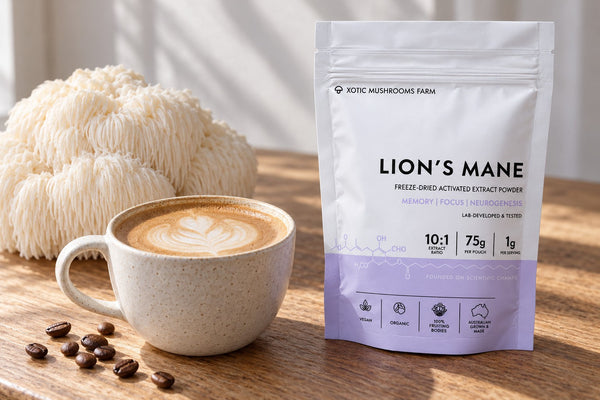
Yes. Lion's Mane extract powder stirs easily into hot coffee, and its mild, earthy flavour blends well with espresso, milk and cacao. Because the extract has already been through hot-water extraction, a hot drink suits it. Stir well or use a frother to avoid clumps, and follow the label serve.
Source Lion’s Mane extract powder at scale
Australian-grown 10:1 fruiting body extract in 1 kg and 5 kg bags, with named-lab testing and white label supply for growing brands.
Request a sample or quote
Related articles
 7 October 2026
Best Mushroom Coffee in Australia: What to Look For on the LabelLooking for the best mushroom coffee in Australia? Use this label checklist to compare mushroom type, extract ratio,...
7 October 2026
Best Mushroom Coffee in Australia: What to Look For on the LabelLooking for the best mushroom coffee in Australia? Use this label checklist to compare mushroom type, extract ratio,...
 7 October 2026
Mushroom Extract in Australia: What Buyers Should CheckBuying mushroom extract in Australia? Learn how to check the extract ratio, fruiting body source, beta-glucans, extraction method,...
7 October 2026
Mushroom Extract in Australia: What Buyers Should CheckBuying mushroom extract in Australia? Learn how to check the extract ratio, fruiting body source, beta-glucans, extraction method,...
 7 October 2026
Mushroom Coffee in Australia: What It Is and How to ChooseA clear guide to mushroom coffee in Australia: what it is, which mushrooms are used, what to check...
7 October 2026
Mushroom Coffee in Australia: What It Is and How to ChooseA clear guide to mushroom coffee in Australia: what it is, which mushrooms are used, what to check...
Get farm and supply updates
New batches, lab results and bulk pricing, a few times a year.