Is Lion's Mane Safe? What We Know and What We Don't

Introduction
Is lion's mane safe? It is one of the first questions people ask before trying this mushroom, and it deserves a straight answer rather than marketing. Lion's Mane has a long history as a culinary mushroom, yet human research on concentrated supplements is still small and short term. This guide sets out what the studies show, which side effects have been reported, who should speak with a GP or pharmacist first, and how Lion's Mane is regulated in Australia. It finishes with checks for brands.
Is Lion's Mane Safe? The Short Answer
Lion's Mane is generally well tolerated in the small human studies published so far, but long-term safety data is limited, so it is not risk free for everyone. That is the honest position, and it is the one we take as a grower and supplier.
Lion's Mane (Hericium erinaceus) has been eaten as a food in parts of Asia for centuries and is traditionally used in East Asian food culture. That history is reassuring for the whole mushroom eaten in normal amounts. Concentrated extracts are a newer way of consuming it, and the research on them is still catching up.
The table below separates what is reasonably established from what is still unclear.
| What we know | What we don't know yet |
|---|---|
| Lion's Mane has a long history of culinary use | Long-term safety of daily extract use beyond a few months |
| Small human trials have reported few adverse effects | Safety in pregnancy, breastfeeding and children |
| Mild stomach upset and skin reactions have been reported | How often reactions occur in the wider population |
| People with mushroom allergies can react | Whether it meaningfully interacts with specific medications |
| Product quality varies between brands | Whether results differ between extracts, powders and mycelium products |
What Human Research Shows So Far

Published human studies on Lion's Mane are few, small and mostly short, and they have generally reported good tolerability. Most of the wider research has been done in cell cultures or animals, which cannot simply be applied to people.
A 2025 systematic review in Frontiers in Nutrition pulled together the human evidence on Hericium erinaceus as a supplement. It found that adverse effects reported in trials were uncommon and generally mild, while noting that study sizes were small, durations were short and products varied widely.
One example is a 2023 randomised controlled trial in healthy young adults, which looked at acute and 28-day intake of a Lion's Mane supplement. Participants tolerated it well, but 41 people over four weeks cannot tell us what happens over years.
So the evidence is encouraging on short-term tolerability and thin on everything else. Lion's Mane is often researched for cognitive and nervous system support, but research interest is not the same as proof, and it should never be used in place of medical care. Anyone telling you the safety question is completely settled is going further than the evidence allows.
Reported Side Effects and Allergies
The side effects most often reported with Lion's Mane are mild digestive discomfort and, less commonly, skin reactions or allergic responses. Serious reactions appear to be rare, but they have been documented.
Users and studies describe things like stomach upset, bloating, nausea or loose stools, usually when starting out or taking more than the label suggests. The Memorial Sloan Kettering integrative medicine database notes that abdominal discomfort, nausea and skin rash were reported in a clinical study, which reinforces that people with mushroom allergies or sensitivities should be cautious.
If you notice a rash, itching, swelling or difficulty breathing after taking Lion's Mane, stop and seek medical advice straight away. For a fuller breakdown, see our guide to Lion's Mane side effects.
Who Should Talk to a GP or Pharmacist First?
Anyone who is pregnant, breastfeeding, taking medication, managing a health condition or allergic to mushrooms should speak with a GP or pharmacist before taking Lion's Mane. This is general information, not personal medical advice.
- Pregnancy and breastfeeding: there is no reliable human safety data, so caution is the sensible default.
- Prescription medication: interaction research is limited, and some sources raise theoretical concerns with blood-thinning and blood glucose medicines. A pharmacist can check your specific medicines.
- Mushroom allergies: people sensitive to other mushrooms or moulds may react.
- Upcoming surgery: mention any supplements to your surgical team.
- Children: safety has not been established, so speak with a doctor before giving any mushroom supplement to a child.
Taking a label to your appointment helps, because it shows the exact ingredients, extract type and serving size.
How Lion's Mane Is Regulated in Australia
In Australia, Lion's Mane can sit under food rules or therapeutic goods rules depending on how a product is presented and what it claims. That distinction matters for both safety and labelling.
TGA guidance
The Therapeutic Goods Administration updated its guidance on 17 October 2024. It treats Lion's Mane as a novel food and indicates that extracts presented with dosage instructions or therapeutic claims are likely to be therapeutic goods, which bring their own requirements.
FSANZ and novel foods
Food Standards Australia New Zealand sets the food standards for Australia and New Zealand, including the rules for novel foods that lack a history of traditional use in the Australian diet. For shoppers, the takeaway is to be wary of any Lion's Mane product that promises to treat, cure or prevent a condition.
Product Quality Is Part of Safety

A large part of Lion's Mane safety comes down to the product itself: what is in it, where it was grown and how it was tested. Mushrooms can absorb heavy metals from their growing medium, and poorly handled powders can carry microbial contamination.
Look for a clear fruiting body source, a full ingredient list and recent results from an independent laboratory. Our guide on how to check Lion's Mane lab results explains what to look for.
Our own extract is 100% Lion's Mane fruiting body, grown in Thomastown, Victoria, with no mycelium, grain or fillers. AEGIC tested a sample for heavy metals and nutrition in November 2024, and RMIT University researchers found no E. coli or coliforms in April 2025. Pesticides have not yet been tested, and every result applies only to the sample tested. The full detail sits on our specifications and testing page.
Being open about what has and has not been tested is part of selling responsibly.
For Brands: Checks Before Selling Lion's Mane in Australia
Before selling a Lion's Mane product in Australia, a brand needs supplier documentation, compliant labelling and a clear view of whether its product is a food or a therapeutic good. Getting this wrong creates risk for customers and the business.
- Documentation: certificates of analysis, heavy metal and microbial results, the species, the part of the mushroom used and the extraction method.
- Labelling: accurate ingredients, allergen statements, serving size and no therapeutic claims unless the product is appropriately regulated.
- Regulatory check: review the TGA October 2024 guidance and FSANZ requirements, and get regulatory advice on presentation.
Our article on COAs and testing for Lion's Mane extract products covers documentation in more depth, and our white label Lion's Mane page explains how we support brands.
Conclusion
So, is lion's mane safe? Short-term human research is reassuring, yet long-term and special-population data is missing, so check with a GP or pharmacist if you are unsure. Choose a tested, clearly labelled product like our Lion's Mane extract powder. Brands can ask about white label supply.
FAQs
Is it safe to take Lion's Mane every day?
Small human studies lasting up to a few months have generally reported good tolerability with daily use, but long-term data is limited. If you plan to take Lion's Mane daily, follow the label serving and speak with your GP or pharmacist, especially if you take medication, have a health condition or have reacted to mushrooms before.
Is Lion's Mane safe during pregnancy or breastfeeding?
There is no reliable human research on Lion's Mane supplements during pregnancy or breastfeeding, so safety has not been established. The cautious approach is to avoid concentrated supplements during these times unless your doctor or midwife advises otherwise. Culinary amounts of the whole mushroom are a separate question to raise with your health professional.
Can Lion's Mane interact with medication?
Interaction research is limited. Some sources raise theoretical concerns with medicines that affect blood clotting or blood glucose, although clear human evidence is lacking. Because individual medicines and conditions vary, ask your pharmacist or GP to check before combining Lion's Mane with any prescription or over-the-counter medication.
Can you be allergic to Lion's Mane?
Yes. Case reports describe skin reactions such as contact dermatitis and, rarely, breathing difficulty linked to Lion's Mane. People with known mushroom or mould allergies may be more likely to react. If you notice a rash, itching, swelling or breathing difficulty, stop taking it and seek medical advice promptly.
Is Lion's Mane legal in Australia?
Yes, Lion's Mane products can be legally sold in Australia. The TGA's guidance updated on 17 October 2024 treats Lion's Mane as a novel food, and extracts presented with dosage instructions or therapeutic claims are likely to be therapeutic goods. How a product is labelled and marketed determines which regulatory framework applies.
Is Lion's Mane safe for children?
Safety in children has not been established through research, and supplement products are generally formulated and labelled for adults. Speak with a doctor before giving any Lion's Mane supplement to a child. Do not rely on online claims or adult serving sizes when making this decision for a young person.
How can I tell if a Lion's Mane product is good quality?
Look for a clearly stated fruiting body source, a full ingredient list without unnecessary fillers, and recent results from an independent laboratory covering heavy metals and microbial contamination. A trustworthy brand will also tell you which tests have not been done and that each result applies to the specific sample tested.
Source Lion’s Mane extract powder at scale
Australian-grown 10:1 fruiting body extract in 1 kg and 5 kg bags, with named-lab testing and white label supply for growing brands.
Request a sample or quote
Related articles
 7 October 2026
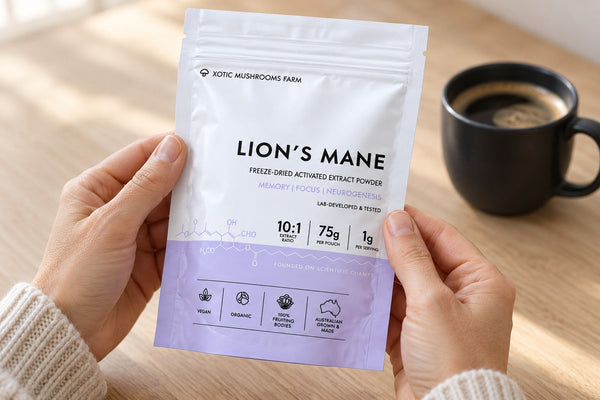
Best Mushroom Coffee in Australia: What to Look For on the LabelLooking for the best mushroom coffee in Australia? Use this label checklist to compare mushroom type, extract ratio,...
7 October 2026
Best Mushroom Coffee in Australia: What to Look For on the LabelLooking for the best mushroom coffee in Australia? Use this label checklist to compare mushroom type, extract ratio,...
 7 October 2026
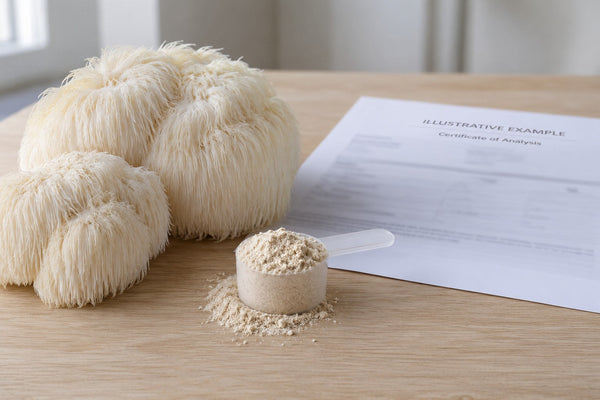
Mushroom Extract in Australia: What Buyers Should CheckBuying mushroom extract in Australia? Learn how to check the extract ratio, fruiting body source, beta-glucans, extraction method,...
7 October 2026
Mushroom Extract in Australia: What Buyers Should CheckBuying mushroom extract in Australia? Learn how to check the extract ratio, fruiting body source, beta-glucans, extraction method,...
 7 October 2026
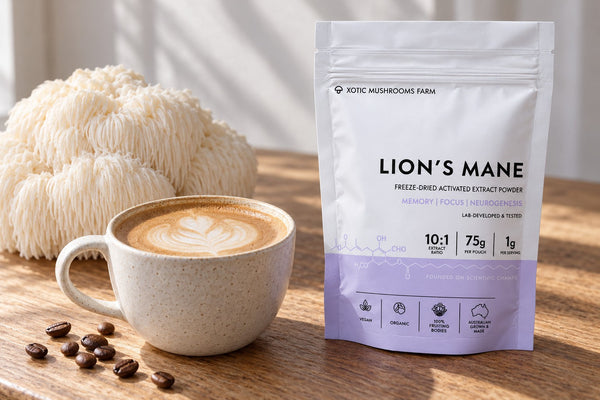
Mushroom Coffee in Australia: What It Is and How to ChooseA clear guide to mushroom coffee in Australia: what it is, which mushrooms are used, what to check...
7 October 2026
Mushroom Coffee in Australia: What It Is and How to ChooseA clear guide to mushroom coffee in Australia: what it is, which mushrooms are used, what to check...
Get farm and supply updates
New batches, lab results and bulk pricing, a few times a year.