Mushroom Supplements in Australia: How to Compare Them

Introduction
Choosing a mushroom supplement in Australia is harder than it looks, because two products with the same mushroom on the front can be made in very different ways. This guide gives you a simple way to compare them: which species you are buying, which part of the mushroom is used, how strong the extract is, how it has been tested, which format suits you and what each serve really costs. It is written for everyday shoppers, with a short section for brands and businesses buying in bulk.
What should you compare in a mushroom supplement in Australia?
Compare six things: the species, the part of the mushroom used, the extract ratio, the testing, the format and the cost per serve.
Most retail pages lead with branding and lifestyle images, so the useful detail often sits in the fine print or on a separate specifications page. If a brand will not tell you what part of the mushroom it uses, or cannot show a recent lab report, treat that as a gap in the information rather than a small omission.
| What to check | What good looks like | Red flag |
|---|---|---|
| Species | Latin name on the label, for example Hericium erinaceus | A vague blend with no amounts |
| Part used | Fruiting body stated clearly | Mycelium on grain, or no mention at all |
| Extract ratio | Ratio and method stated, for example 10:1 dual extraction | A ratio with no method |
| Testing | Named lab, report date, beta-glucan result | A lab tested claim with nothing to show |
| Format | Suits how you will actually take it | Format chosen for novelty only |
| Cost per serve | Easy to calculate from serve size | Serve size hidden or unclear |
Which mushroom species are most common?

Lion's Mane, reishi, cordyceps, turkey tail and chaga are the species you will see most often on Australian shelves. Each has its own history and research interest, so a blend is not automatically better than a single mushroom.
Lion's Mane (Hericium erinaceus) is often researched for its role in cognitive wellbeing and is commonly associated with focus routines. Reishi is traditionally used in East Asian practice for calm and balance. Cordyceps is commonly associated with energy and exercise routines, while turkey tail and chaga are often researched for their polysaccharide content. For a fuller tour of each species, see our plain-English guide to functional mushrooms.
When a product blends several species, look for the amount of each one per serve. A long list of mushrooms in a small total dose can mean each species is present only in small quantities.
Fruiting body, mycelium and extract ratio
The fruiting body is the mushroom you can see and pick, and it is where most of the beta-glucans studied in research are measured. Mycelium is the root-like network, and when it is grown on grain the final powder can carry a share of that grain as starch.
The extract ratio tells you how much raw mushroom went into the finished powder. A 10:1 ratio means about ten parts of dried mushroom were concentrated into one part of extract. At Xotic Mushrooms, fruiting bodies are harvested, freeze-dried and processed into a 10:1 extract, which we explain on our 10:1 fruiting body label guide.
A ratio on its own is only half the story, because the method matters too. Hot-water extraction draws out water-soluble compounds such as beta-glucans, while ethanol reaches compounds that are less soluble in water. Dual extraction uses both.
Capsules, powder, liquid or gummies?
The best format is the one you will take consistently, and each has trade-offs in convenience, flexibility and added ingredients.
- Capsules: measured, tasteless and easy to travel with. You are limited to the dose in each capsule.
- Powder: flexible and usually the lowest cost per serve. It mixes into coffee, smoothies or cacao but has an earthy taste.
- Liquid extracts: quick to take, though the alcohol or glycerine base and the strength per millilitre vary a lot.
- Gummies: pleasant to take, but they usually contain sugars or sweeteners and less room for active extract.
Xotic Mushrooms makes powder and capsules only. Our Lion's Mane extract powder has a 1 g serve on the label, and our Lion's Mane capsules list 2 x 300 mg per serve.
How to read testing and regulatory claims

A credible product can show who tested it, when, and what was measured, and it uses careful wording about benefits. Ask for the certificate of analysis (COA) and check the lab name, the date and whether results apply to the batch or a sample.
In Australia, some mushroom products are listed medicines on the Australian Register of Therapeutic Goods, while many powders are sold as foods. The two categories follow different rules, so be cautious of food products making strong health claims.
For transparency, our own results are published on our specifications and testing page. A Symbio Laboratories COA (S2162602 [R01], 13 May 2026) measured 32.2% beta-glucans in the tested extract powder blend with 1% BioPerine. This is a sample-specific result, not a guarantee for every finished product. An earlier AEGIC sample (Nov 2024) measured 24.5 g/100 g. Results apply to the samples tested, and pesticide testing has not yet been completed.
How to compare price per serve
Divide the price by the number of label serves, then compare products at the same extract ratio. A cheaper pouch can cost more per serve once you account for a larger serve size or a weaker ratio.
For example, a 75 g pouch at a 1 g label serve gives 75 serves. Compare that figure with a capsule bottle by dividing the bottle price by the number of serves it holds. Then check that both products use the fruiting body at a similar ratio, otherwise you are comparing different ingredients.
Buying for a brand or business?
If you are buying mushroom extract for a brand, cafe or manufacturer, the checklist becomes a specification. You will want a written spec sheet, a current COA for each batch, minimum order quantities (MOQ), consistent supply and a sample before you commit.
We supply Lion's Mane extract in 1 kg and 5 kg bulk packs and work with brands on white label Lion's Mane. Ask about samples and documentation before you plan a launch.
Conclusion
The easiest way to compare a mushroom supplement in Australia is to check the species, the part used, the ratio, the testing, the format and the cost per serve. If you want a fruiting body Lion's Mane extract grown in Victoria, explore our powder and capsules. Brands can ask us about bulk and white label supply.
FAQs
Do mushroom supplements work?
Mushroom supplements are often researched for their beta-glucans and other compounds, and results vary by species, dose and study design. Research on Lion's Mane is still developing. A supplement may support a wellness routine, but it is not a substitute for medical care. Choose products that show their extraction method and testing.
What is the best form of mushroom supplement?
The best form is the one you will take consistently. Capsules suit people who want a measured, tasteless dose. Powder is flexible and usually cheaper per serve. Liquids are quick but vary in strength, and gummies often contain added sugars. Compare the extract ratio and the part used, not just the format.
Are Australian grown mushroom supplements better?
Australian grown products give you a shorter, more traceable supply chain, but origin alone does not guarantee quality. Check the part used, the extract ratio and recent lab results. Xotic Mushrooms grows Lion's Mane in Thomastown, Victoria, on Tasmanian oak sawdust and Australian soya husk, then extracts the fruiting body.
What does 10:1 mean on a mushroom supplement label?
A 10:1 ratio means about ten parts of dried mushroom were concentrated into one part of finished extract. It describes how concentrated the powder is, not its exact beta-glucan level. Look for the ratio alongside the extraction method and a lab result, since all three together give a clearer picture of quality.
Are mushroom supplements regulated in Australia?
Yes, but under different frameworks. Some mushroom products are listed medicines regulated by the TGA and appear on the ARTG, while many powders are sold as foods under food standards. Listed medicines can make limited approved claims. Food products should avoid therapeutic claims, so strong health promises on a food powder are a warning sign.
How do I check a mushroom supplement has been tested?
Ask the brand for its certificate of analysis. A useful COA names the laboratory, the report number and date, and shows results such as beta-glucans, heavy metals and microbial counts. Remember that results apply to the sample tested, so newer batches should have their own testing or a clear testing schedule.
Source Lion’s Mane extract powder at scale
Australian-grown 10:1 fruiting body extract in 1 kg and 5 kg bags, with named-lab testing and white label supply for growing brands.
Request a sample or quote
Related articles
 7 October 2026
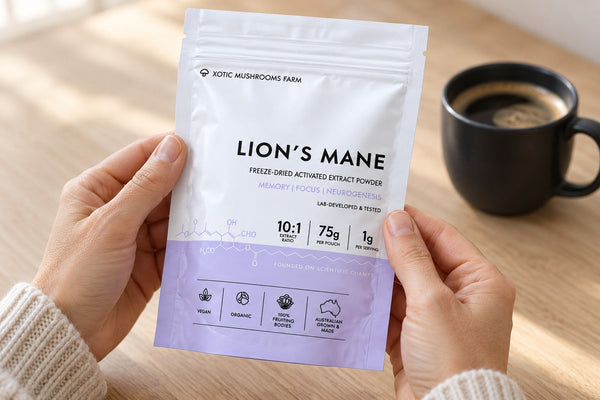
Best Mushroom Coffee in Australia: What to Look For on the LabelLooking for the best mushroom coffee in Australia? Use this label checklist to compare mushroom type, extract ratio,...
7 October 2026
Best Mushroom Coffee in Australia: What to Look For on the LabelLooking for the best mushroom coffee in Australia? Use this label checklist to compare mushroom type, extract ratio,...
 7 October 2026
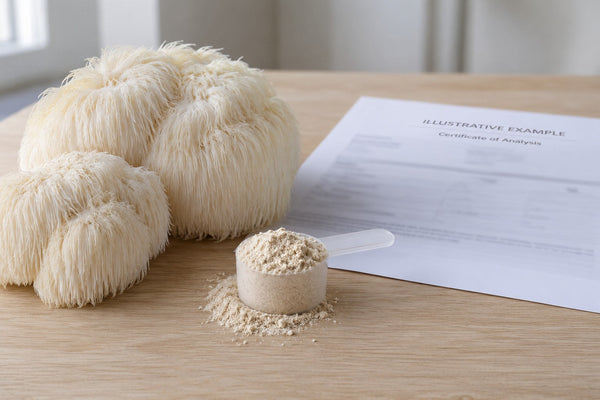
Mushroom Extract in Australia: What Buyers Should CheckBuying mushroom extract in Australia? Learn how to check the extract ratio, fruiting body source, beta-glucans, extraction method,...
7 October 2026
Mushroom Extract in Australia: What Buyers Should CheckBuying mushroom extract in Australia? Learn how to check the extract ratio, fruiting body source, beta-glucans, extraction method,...
 7 October 2026
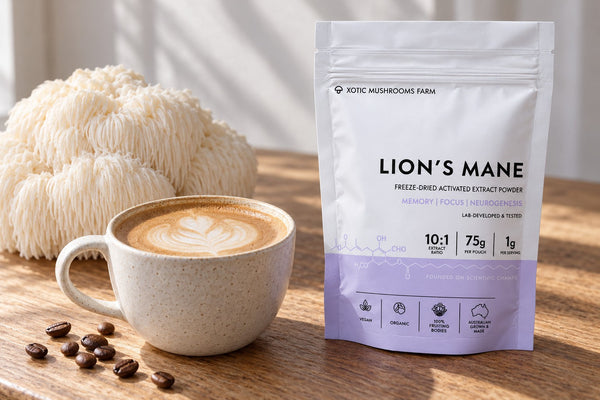
Mushroom Coffee in Australia: What It Is and How to ChooseA clear guide to mushroom coffee in Australia: what it is, which mushrooms are used, what to check...
7 October 2026
Mushroom Coffee in Australia: What It Is and How to ChooseA clear guide to mushroom coffee in Australia: what it is, which mushrooms are used, what to check...
Get farm and supply updates
New batches, lab results and bulk pricing, a few times a year.