Best Mushroom Coffee in Australia: What to Look For on the Label

Introduction
Search for the best mushroom coffee in Australia and you will find ranked lists, influencer picks and shelves full of bold packaging. Rankings date quickly, though, and rarely explain why one product beats another. This guide takes a different route. Instead of naming winners, it shows you exactly what to check on the label: the mushroom and part used, extract strength, amount per serve, testing, ingredients and real value. With these criteria, you can judge any mushroom coffee yourself in a couple of minutes.
What Makes the Best Mushroom Coffee in Australia?
The best mushroom coffee in Australia is the one that clearly states a meaningful amount of fruiting body extract per serve, backs it with published testing, and suits how you like your coffee. Branding, influencer reviews and price alone do not tell you this.
Mushroom coffee is a broad category. Some products are mostly instant coffee with a small sprinkle of mushroom, while others are concentrated extracts designed to be added to your own brew. If you are new to the category, start with our guide to mushroom coffee in Australia, which explains formats and how it is made.
Personal fit matters too. A great product for someone who drinks instant at work may be a poor fit for a home espresso drinker. Decide first whether you want convenience (a pre-mixed blend) or control (extract powder added to your usual coffee), then use the label checklist below to compare options within that format.
Keep expectations grounded. Lion's Mane is often researched for its relationship with cognitive function, and early human studies are promising but modest. No label can promise a specific result, and any product that does is a warning sign rather than a selling point.
The Label Checklist
Use these six criteria to compare any mushroom coffee on the shelf or online.
| What to check | What good looks like | Why it matters |
|---|---|---|
| Mushroom part | Fruiting body stated clearly | Fruiting body is the mushroom itself, with less risk of grain starch |
| Extract type and ratio | Extract with a stated ratio, such as 10:1 | Shows the powder has been concentrated, not just ground |
| Amount per serve | Milligrams of each mushroom listed | Lets you compare products like for like |
| Beta-glucans | A tested figure, ideally from a named lab | A useful quality marker for mushroom extracts |
| Testing and origin | COA, heavy metals, microbial testing, country of origin | Confirms safety and consistency of the batch |
| Other ingredients | Short list, no unnecessary fillers or sugars | Keeps the mushroom, not additives, as the focus |
A product does not need to tick every box to be worth buying, but the more boxes it leaves blank, the harder it is to know what you are paying for.
Mushroom Type and Part Used

Look for products that name the mushroom species and state that the fruiting body was used. The species tells you what you are drinking, and the part used tells you a lot about quality.
The fruiting body is the visible mushroom that grows above the substrate. Mycelium is the root-like network beneath it. Many lower-cost products use mycelium grown on rice or oats, and because the grain is harvested with it, the final powder can contain a significant share of starch rather than mushroom compounds.
Neither part is inherently dangerous, but fruiting body products give you more certainty that you are paying for mushroom. Our explainer on the 10:1 fruiting body label walks through how this appears on a pack.
Single-mushroom coffees are also easier to assess than five or six mushroom blends, where each species may only appear in a very small quantity.
Extract Ratio, Beta-Glucans and Amount per Serve
A stated extract ratio, a tested beta-glucan figure and a clear amount per serve are the three best indicators of strength on a mushroom coffee label.
An extract ratio such as 10:1 means roughly ten parts of raw mushroom went into one part of extract. It describes input versus output, not potency. Dual extraction with hot water and ethanol is commonly used to draw out both water-soluble polysaccharides and alcohol-soluble compounds. Plain ground mushroom powder has no ratio because it has not been concentrated.
Beta-glucans are polysaccharides commonly associated with the functional value of mushrooms. Look for a percentage or grams per 100 g from a named laboratory rather than vague terms like rich in polysaccharides, since some tests also count starch. For reference, a Symbio Laboratories COA (S2162602 [R01], 13 May 2026) recorded 32.2% beta-glucans in the tested extract powder blend with 1% BioPerine. This is a sample-specific result, not a guarantee for every finished product.
Finally, find the milligrams of mushroom per serve. A proprietary blend that lists only a total weight for several ingredients makes it impossible to know how much mushroom you are actually getting.
Testing, Origin and Ingredients
The best mushroom coffees publish testing results, state where the mushrooms are grown and keep the ingredient list short.
Mushrooms absorb what they grow on, so heavy metal testing matters. Microbial testing confirms the batch is free of contaminants such as E. coli. Ask for a COA if one is not published, and check it is recent and matches the product. Our guide on how to check Lion's Mane lab results explains what to look for.
Origin is often missing from labels. Many mushroom ingredients sold in Australia are imported, which is not a problem in itself, but traceability is easier when the grower is named. Read more about Australian-grown Lion's Mane and why it is uncommon.
On ingredients, watch for sugar, creamer powders, gums and flavours. They are not necessarily bad, but they take up room in each serve that could otherwise be coffee or mushroom.
Working Out Value per Serve
Compare mushroom coffees by the cost of the mushroom per serve, not by the price of the tub. A cheaper tub can be poor value if each serve contains very little mushroom.
- Divide the pack price by the number of serves to get cost per serve.
- Find the milligrams of mushroom extract per serve on the label.
- Divide cost per serve by grams of mushroom to compare products fairly.
- Adjust for quality: a stated fruiting body extract with testing is worth more than an unspecified powder.
Adding extract powder to coffee you already buy is often the simplest way to see value clearly. Our Lion's Mane extract powder lists a 1 g label serving, with 75 serves in a 75 g pouch, so the maths takes seconds. Shipping is free in Australia on orders over A$100.
Red Flags to Avoid
Be cautious with any mushroom coffee that hides key information or makes big promises. Common red flags include:
- Proprietary blends with no milligrams per mushroom.
- Mycelium on grain without a starch or beta-glucan figure.
- No testing or a COA you cannot access.
- Medical claims about treating, curing or preventing conditions.
- Psychedelic-style marketing that implies a high. Functional mushrooms such as Lion's Mane are not psychoactive.
For Cafes and Coffee Brands

Cafes and coffee brands adding a mushroom blend should apply the same label checklist to their supplier. Customers increasingly ask these questions, and good answers become a selling point.
Look for fruiting body extract, a stated ratio, a current COA and consistent batches that dissolve cleanly in espresso and milk. We supply Lion's Mane extract in 1 kg and 5 kg bulk formats and offer white label options for retail blends. Keep menu and pack wording compliant, using phrases such as may support.
Find out more about our white label Lion's Mane supply.
Conclusion
The best mushroom coffee in Australia is the one with a transparent label: fruiting body extract, a stated ratio, clear milligrams per serve and published testing. Use the checklist to compare any product. To build your own, try our Australian-grown Lion's Mane extract powder. Cafes and brands can ask about bulk and white label supply.
FAQs
What is the best mushroom coffee in Australia?
There is no single best product for everyone. The best mushroom coffee for you clearly lists fruiting body extract, a stated extract ratio, milligrams per serve and published testing, and suits how you drink coffee. Use a label checklist to compare products rather than relying on ranked lists or packaging claims.
Do mushroom coffees actually work?
Mushroom coffees are foods, not treatments, so results vary. Lion's Mane is often researched for cognitive function, with modest findings in early human studies. Whether a product delivers anything depends on how much quality mushroom extract it contains, which is why the amount per serve and testing matter.
What is the downside to mushroom coffee?
Common downsides are higher cost than regular coffee, an earthy taste, and labels that do not disclose how much mushroom is inside. Some people notice mild digestive upset with new foods. Anyone with a mushroom allergy, a medical condition or taking medication should check with a doctor first.
Is fruiting body better than mycelium?
Fruiting body is the mushroom itself, so products made from it are less likely to contain grain starch. Mycelium products are often grown on rice or oats, which can end up in the final powder. For clearer value, look for fruiting body extract with a tested beta-glucan figure.
How much Lion's Mane should be in mushroom coffee?
There is no official standard amount. Instead, look for a label that states the milligrams of Lion's Mane per serve, and compare products on that figure. For our extract powder the label serving is 1 g, which you can add to your own coffee. Follow the label serving of whichever product you choose.
Is Australian-grown mushroom coffee better?
Australian-grown is not automatically better, but it can make traceability and testing easier to verify. Most mushroom ingredients are imported. Whatever the origin, check for fruiting body extract, a named grower or supplier, and published testing for heavy metals and microbes.
Source Lion’s Mane extract powder at scale
Australian-grown 10:1 fruiting body extract in 1 kg and 5 kg bags, with named-lab testing and white label supply for growing brands.
Request a sample or quote
Related articles
 7 October 2026
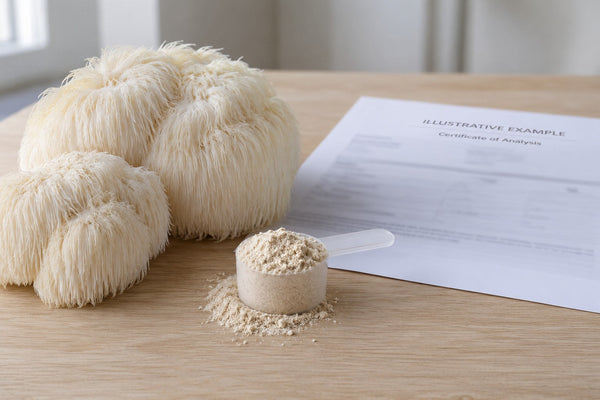
Mushroom Extract in Australia: What Buyers Should CheckBuying mushroom extract in Australia? Learn how to check the extract ratio, fruiting body source, beta-glucans, extraction method,...
7 October 2026
Mushroom Extract in Australia: What Buyers Should CheckBuying mushroom extract in Australia? Learn how to check the extract ratio, fruiting body source, beta-glucans, extraction method,...
 7 October 2026
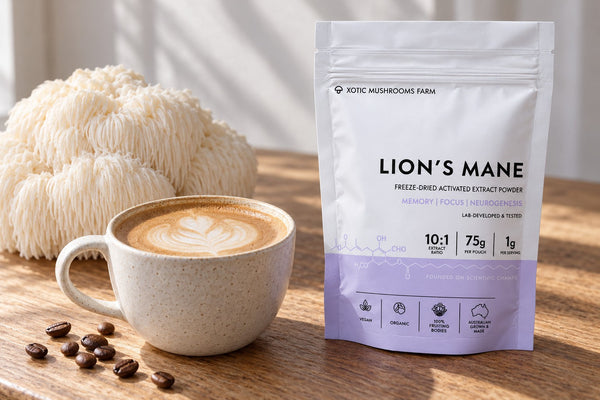
Mushroom Coffee in Australia: What It Is and How to ChooseA clear guide to mushroom coffee in Australia: what it is, which mushrooms are used, what to check...
7 October 2026
Mushroom Coffee in Australia: What It Is and How to ChooseA clear guide to mushroom coffee in Australia: what it is, which mushrooms are used, what to check...
 7 October 2026
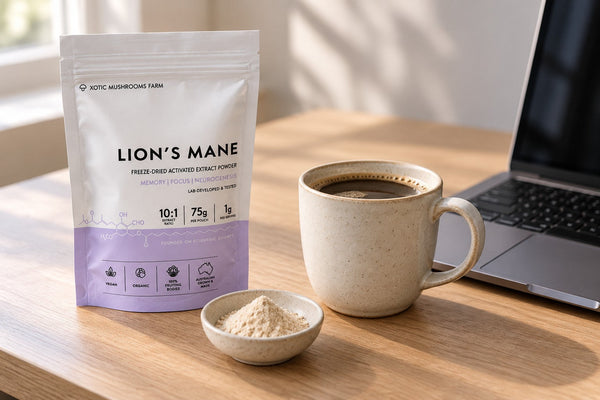
Does Lion's Mane Make You High?Does lion's mane make you high? No. Here is what people actually notice, plus drug tests, driving, work...
7 October 2026
Does Lion's Mane Make You High?Does lion's mane make you high? No. Here is what people actually notice, plus drug tests, driving, work...
Get farm and supply updates
New batches, lab results and bulk pricing, a few times a year.