Australian-Grown Lion's Mane: Why Provenance Matters

Introduction
When you buy Australian-grown Lion's Mane, the origin on the pack should tell you something real about where the mushroom came from and how it reached you. This guide explains what origin wording means on Australian labels, why traceability matters for a mushroom product, how a shorter supply chain helps, and the simple questions you can ask to check whether an origin claim holds up. It is a neutral guide, so you can apply it to any brand, including ours.
What does Australian-grown mean on a label?
"Grown in Australia" means the ingredients were grown in Australia and the product was made or processed here. It is a stronger claim than "Made in Australia", which can include imported ingredients that were processed locally, or "Packed in Australia", which may only mean the final packing happened here.
For many foods sold in Australia, the country of origin food labelling rules set out how these claims must be shown. Products regulated as therapeutic goods can follow different rules, so wording varies across the category.
| Label wording | What it generally tells you |
|---|---|
| Grown in Australia | Ingredients grown here and the product made or processed here |
| Product of Australia | Significant ingredients from Australia and processing done here |
| Made in Australia | Processed here; ingredients may be local or imported |
| Packed in Australia | Packed here; ingredients may come from elsewhere |
Read origin wording carefully. A flag or a map on the front of a pack is not the same as a clear statement of where the mushroom was grown.
Why traceability matters for Lion's Mane
Traceability means a product can be followed back through each step to where it was grown, and it is what makes every other quality claim checkable. If a brand knows exactly which farm, substrate and harvest its mushroom came from, it can answer questions and investigate problems properly.
Mushrooms take up nutrients, and potentially contaminants, from what they grow on. Knowing the growing substrate is therefore part of understanding the product. Our Lion's Mane, for example, is grown on Tasmanian oak hardwood sawdust and Australian soya husk, as listed on our specifications and testing page.
Traceability also links the product to its lab results. A report is far more meaningful when the brand can show it came from the same source as the product on the shelf.
Food standards and labelling
Products sold in Australia must meet Australian rules, which gives buyers a common baseline to check against. Food products are covered by the Australia New Zealand Food Standards Code, while country of origin claims fall under consumer law.
Those rules apply to anything sold here, imported or local, so origin alone does not make a product safe or unsafe. What a local grower can offer is direct knowledge of the whole process, from growing room to finished powder, under one set of rules.
When origin, process and testing all sit with the same business, there are fewer gaps where information can be lost between suppliers.
A shorter, fresher supply chain

A shorter supply chain means fewer hands, fewer handovers and less time between harvest and processing. When the mushroom is grown and processed close together, it can move from harvest into drying quickly rather than travelling long distances first.
We grow our Lion's Mane on our farm in Thomastown, Victoria, and our products are made from 100% Hericium erinaceus fruiting body, freeze-dried and made into a 10:1 extract. You can see how that works on our farm and process page.
A shorter chain also makes communication simpler. If you have a question about a product, the people answering are the people who grew it.
How to verify an origin claim
The best way to check a provenance claim is to ask specific questions and see whether the answers are specific too. Useful questions include:
- Where exactly is the mushroom grown, and by whom?
- Is it the fruiting body, and what is it grown on?
- Where is it dried and processed?
- Does the label say Grown in, Product of, Made in or Packed in?
- Are lab results published, and do they match this product?
Vague answers are not proof of a problem, but clear ones are a good sign. Our checklist on how to check a Lion's Mane product's lab results covers the testing side in more detail.
Where our Lion's Mane is grown
Our Lion's Mane is grown on our own farm in Thomastown, Victoria. Our products are organic, made from the fruiting body only and freeze-dried before extraction.
Our Lion's Mane extract powder comes in 50 g, 75 g, 150 g, 300 g and 1.2 kg sizes, and our capsules contain 300 mg of 10:1 extract in packs of 60 or 120. Brands wanting traceable Australian supply under their own label can ask about our white label Lion's Mane service.
Conclusion
Provenance is about more than a flag on the pack. Australian-grown Lion's Mane should come with clear origin wording, a traceable path from farm to powder and lab results that match the product. Ask specific questions, read the label carefully, and choose brands that answer openly.
FAQs
What is the difference between grown in Australia and made in Australia?
Grown in Australia generally means the ingredients were grown here and the product was made or processed here. Made in Australia means the product was processed here, but the ingredients may be imported. For a mushroom product, grown in tells you far more about where the Lion's Mane itself came from.
Is Australian-grown Lion's Mane better?
Origin alone does not make one product better than another. What Australian-grown Lion's Mane can offer is a shorter, more traceable supply chain under Australian rules, with the grower able to answer questions directly. Quality is best judged by combining clear origin, the part of the mushroom used and published lab results.
How can I check where my Lion's Mane was grown?
Read the origin wording on the label, then ask the brand where the mushroom is grown, who grows it, what it is grown on and where it is processed. Specific, consistent answers and published lab results that match the product are good signs that an origin claim is genuine.
Where is Xotic Mushrooms Lion's Mane grown?
Xotic Mushrooms grows its Lion's Mane on its own farm in Thomastown, Victoria. The products are made from 100% Hericium erinaceus fruiting body, freeze-dried and made into a 10:1 extract, available as extract powder and capsules.
Why does the growing substrate matter?
Mushrooms absorb nutrients and potentially contaminants from what they grow on, so the substrate is part of understanding the product. A traceable brand should be able to tell you its substrate. Ours is Tasmanian oak hardwood sawdust and Australian soya husk.
Source Lion’s Mane extract powder at scale
Australian-grown 10:1 fruiting body extract in 1 kg and 5 kg bags, with named-lab testing and white label supply for growing brands.
Request a sample or quote
Related articles
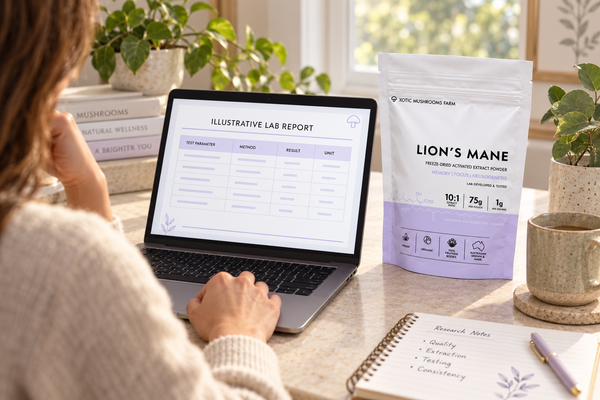 7 October 2026
How to Check a Lion's Mane Product's Lab ResultsA simple checklist for checking Lion's Mane lab results: who tested it, whether it is the same product,...
7 October 2026
How to Check a Lion's Mane Product's Lab ResultsA simple checklist for checking Lion's Mane lab results: who tested it, whether it is the same product,...
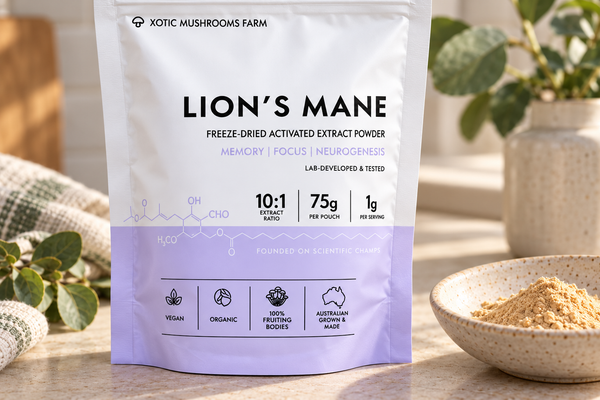 7 October 2026
What "10:1" and "Fruiting Body" Mean on a Lion's Mane LabelWhat does 10:1 mean on a Lion's Mane extract label, and why does fruiting body matter? A short,...
7 October 2026
What "10:1" and "Fruiting Body" Mean on a Lion's Mane LabelWhat does 10:1 mean on a Lion's Mane extract label, and why does fruiting body matter? A short,...
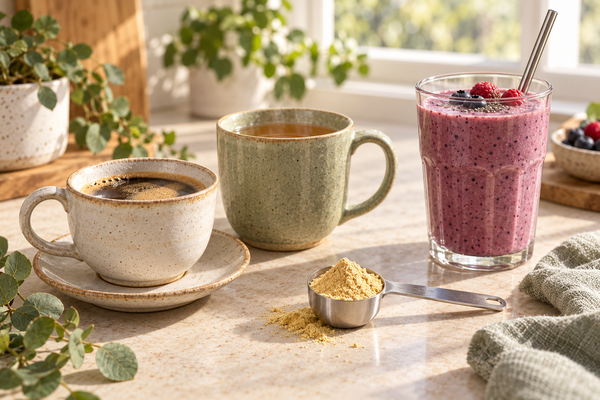 7 October 2026
How to Use Lion's Mane Extract Powder in Coffee, Tea and SmoothiesHow to use Lion's Mane extract powder in coffee, tea and smoothies: a 1 g serving, mixing tips...
7 October 2026
How to Use Lion's Mane Extract Powder in Coffee, Tea and SmoothiesHow to use Lion's Mane extract powder in coffee, tea and smoothies: a 1 g serving, mixing tips...
Get farm and supply updates
New batches, lab results and bulk pricing, a few times a year.