Lion's Mane Powder Australia: How to Choose a Good One

Introduction
Lion's Mane powder in Australia ranges from simple dried and milled mushroom to concentrated dual extracts, and the pouches can look almost identical. That makes choosing harder than it should be. This guide explains what separates a good Lion's Mane powder from a weak one, how extract powder differs from whole mushroom powder, which label details matter, and what testing should back them up. You will also find practical checks for when the pouch arrives, plus a short section for cafes and brands buying in larger volumes.
What Makes a Good Lion's Mane Powder?
A good Lion's Mane powder is made from the fruiting body, clearly states its extract ratio and method, lists no fillers and is backed by independent testing you can read.
Those five points cover most of what separates a carefully made powder from a generic one. The fruiting body is the mushroom itself, as opposed to mycelium grown on grain, which can carry starch from the grain into the final product.
The extract ratio and method tell you how the powder was concentrated. Hot water extraction draws out water-soluble polysaccharides such as beta-glucans, while ethanol targets other compounds, so a dual extract covers both.
Finally, a clean ingredient list and a named laboratory report show the seller has nothing to hide. If any of these five points is missing, ask before you buy.
Extract Powder vs Whole Mushroom Powder

Extract powder is concentrated through hot water and often ethanol, while whole mushroom powder is simply dried and milled, so they differ in strength, texture and how they mix.
| Feature | Extract powder | Whole mushroom powder |
|---|---|---|
| Process | Hot water, often plus ethanol | Dried and milled |
| Concentration | Stated ratio, such as 10:1 | 1:1, not concentrated |
| Quality marker | Tested beta-glucans | Fruiting body content, protein |
| Mixing | Disperses well in hot drinks | Grittier, better in food |
| Typical use | Coffee, lattes, daily serves | Cooking, smoothies, baking |
Neither is wrong, but they are different products and should not be compared on price per gram alone. Our article on extract versus whole mushroom powder goes deeper into the trade-offs.
How to Read a Lion's Mane Powder Label
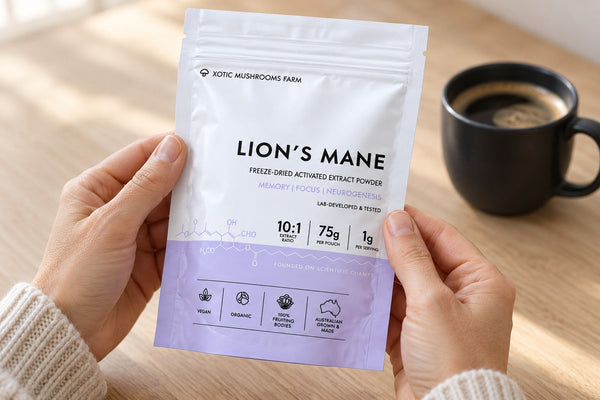
Read a Lion's Mane powder label for four things: the part of the mushroom, the extract ratio, the extraction method and the full ingredient list.
Part of the mushroom
Look for a plain statement such as 100% fruiting body. Vague wording like "full spectrum" or "mushroom complex" can hide mycelium on grain, so ask the seller if the label does not say.
Extract ratio
A 10:1 ratio means about ten parts raw mushroom per part of extract. Our guide to the 10:1 fruiting body label explains why ratio needs testing beside it.
Extraction method
Hot water, ethanol or both should be named. Dual extraction is common for fruiting body extracts, and a clear description shows the producer understands its own process.
Ingredient list
A pure powder lists only Lion's Mane. Any blend, carrier or added ingredient such as BioPerine should be declared plainly, never buried in small print.
Testing That Backs Up the Label
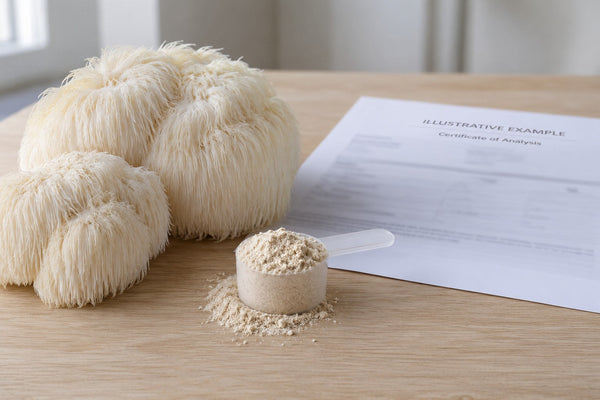
Independent testing turns label claims into evidence, so look for a certificate of analysis from a named laboratory with a report number and date.
The most useful tests for a powder are beta-glucans, heavy metals and microbial checks. Beta-glucans are commonly measured with enzyme-based methods such as the Megazyme mushroom and yeast beta-glucan assay, which separates them from starch-derived alpha-glucans. That matters because some tests for total polysaccharides cannot tell the two apart.
For our own Lion's Mane extract powder, Symbio Laboratories (S2162602 [R01], 13 May 2026) measured 32.2% beta-glucans in the tested extract powder blend with 1% BioPerine, a sample-specific result rather than a guarantee for every finished product, and AEGIC measured 24.5 g/100 g in a historical sample along with heavy metals. RMIT University researchers found no E. coli or coliforms in April 2025. We have not yet tested for pesticides.
All of these results apply to the sample tested, not every batch. The full set is on our specifications and testing page.
Practical Checks Once It Arrives
When your Lion's Mane powder arrives, check its colour, aroma, texture and how it mixes, then store it sealed and dry.
A fruiting body extract is usually a pale cream to light tan colour with a mild, earthy smell. A sour or musty note, damp clumps or visible specks suggest moisture has got in. Fine, even texture is a good sign.
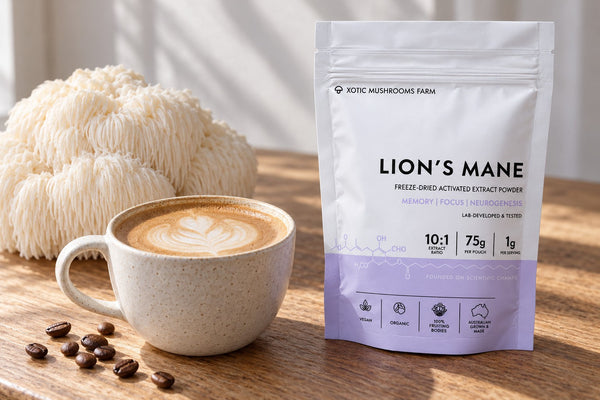
Stir a serve into a hot drink. Extract powders generally disperse well, though a little settling is normal. Our label lists a 1 g serve, which gives 75 serves in a 75 g pouch. For ideas, see how to use Lion's Mane extract powder in coffee, cacao and smoothies.
Keep the pouch closed in a cool, dry cupboard and always use a dry spoon.
Buying for a Brand or Business?
Cafes, supplement brands and manufacturers should judge Lion's Mane powder on a full specification sheet, a current COA, minimum order quantity and a trial sample.
At volume, consistency between batches matters as much as the headline numbers, so ask how the supplier controls growing, drying and extraction. We offer bulk 1 kg and 5 kg packs alongside white label options, and our white label Lion's Mane page has an enquiry form for specifications and samples.
Conclusion
Choosing Lion's Mane powder in Australia comes down to five checks: fruiting body, a stated ratio, a named extraction method, a clean ingredient list and independent testing. If a powder ticks all five, you know what you are buying. Shop our Lion's Mane extract powder, or enquire about bulk supply for your brand.
FAQs
What is the best Lion's Mane powder in Australia?
The best Lion's Mane powder for you is one made from the fruiting body, with a stated extract ratio and method, no fillers and an independent certificate of analysis. Australian grown options make traceability easier to check. Compare products on these criteria rather than on brand claims or price alone.
Is Lion's Mane extract powder stronger than whole powder?
Extract powder is more concentrated, because the mushroom is processed with hot water and often ethanol to draw out compounds such as beta-glucans. Whole powder is simply dried mushroom. Strength is best judged by tested beta-glucan content from a named laboratory, rather than by the ratio on the label alone.
Does Lion's Mane powder dissolve in coffee?
Lion's Mane extract powder disperses well in hot drinks such as coffee, lattes and cacao, though a little may settle at the bottom of the cup. Whole mushroom powder is grittier and suits food better. Stirring the powder into a small amount of hot liquid first helps it mix smoothly.
How much Lion's Mane powder is one serve?
Serve size varies by product, so always follow the label. Our Lion's Mane extract powder label lists a 1 g serve, which works out to 75 serves in a 75 g pouch. If you take medication or are managing a health condition, check with your doctor or pharmacist before using it.
How long does Lion's Mane powder last?
Lion's Mane powder keeps best when sealed in its pouch in a cool, dry place away from sunlight. Check the best before date printed on the pack. Moisture is the main enemy, so use a dry spoon and reseal firmly. Clumping, musty smells or discolouration are signs to replace it.
Is Lion's Mane powder vegan and gluten free?
Pure Lion's Mane powder made only from the fruiting body is naturally vegan, and it can be gluten free if no grain is involved. Our extract powder is vegan, gluten free and non-GMO. Mycelium products grown on grain may differ, so check the label and ask the seller if unsure.
Source Lion’s Mane extract powder at scale
Australian-grown 10:1 fruiting body extract in 1 kg and 5 kg bags, with named-lab testing and white label supply for growing brands.
Request a sample or quote
Related articles
 7 October 2026
Best Mushroom Coffee in Australia: What to Look For on the LabelLooking for the best mushroom coffee in Australia? Use this label checklist to compare mushroom type, extract ratio,...
7 October 2026
Best Mushroom Coffee in Australia: What to Look For on the LabelLooking for the best mushroom coffee in Australia? Use this label checklist to compare mushroom type, extract ratio,...
 7 October 2026
Mushroom Extract in Australia: What Buyers Should CheckBuying mushroom extract in Australia? Learn how to check the extract ratio, fruiting body source, beta-glucans, extraction method,...
7 October 2026
Mushroom Extract in Australia: What Buyers Should CheckBuying mushroom extract in Australia? Learn how to check the extract ratio, fruiting body source, beta-glucans, extraction method,...
 7 October 2026
Mushroom Coffee in Australia: What It Is and How to ChooseA clear guide to mushroom coffee in Australia: what it is, which mushrooms are used, what to check...
7 October 2026
Mushroom Coffee in Australia: What It Is and How to ChooseA clear guide to mushroom coffee in Australia: what it is, which mushrooms are used, what to check...
Get farm and supply updates
New batches, lab results and bulk pricing, a few times a year.