Lion's Mane in Australia: Where to Buy and What to Look For

Introduction
Interest in Lion's Mane in Australia has grown quickly, and so has the number of places selling it. Fresh punnets, dried pieces, powders and capsules now sit side by side online and in health stores, often with very different labels and prices.
This guide explains where you can buy Lion's Mane, how each format differs, and the specific label and testing checks that separate a well-made product from a vague one. It finishes with a short section for brands and cafes buying in bulk.
Where Can You Buy Lion's Mane in Australia?
You can buy Lion's Mane in Australia from local growers, health food stores, pharmacies, online supplement stores and large marketplaces, and the best channel depends on the format you want.
Fresh Lion's Mane is mostly sold by specialty growers and some farmers' markets, because it is delicate and has a short shelf life. If you want it for cooking, buying close to the farm is usually the way to get it in good condition.
Powders and capsules are far easier to find. Health food stores and pharmacies stock a handful of brands, while online stores and grower websites tend to carry a wider range of sizes. Buying direct from a grower that also extracts its own mushrooms gives you the shortest path from farm to pouch, and usually the most detail about how the product was made.
Marketplaces offer convenience, but listings can be thin on detail. Before buying anywhere, look for a clear ingredient list, the part of the mushroom used and some evidence of testing. If those are missing, the price alone tells you very little.
Fresh, Dried, Powder or Capsules: Which Lion's Mane Format Suits You?

Fresh and dried Lion's Mane suit cooking, while extract powder and capsules suit daily routines where you want a measured, consistent serve.
| Format | Best for | Shelf life | What to check |
|---|---|---|---|
| Fresh | Cooking, as a seafood-like ingredient | Days, refrigerated | Firm, white, no yellowing |
| Dried pieces | Broths, soups, rehydrating | Months, sealed | Source and drying method |
| Whole mushroom powder | Food use, smoothies | Months, sealed | Fruiting body only, no fillers |
| Extract powder | Coffee, lattes, measured daily serves | Months, sealed and dry | Extract ratio, tested beta-glucans, extraction method |
| Capsules | Convenience, no taste | Months, sealed | Extract inside, mg per capsule, serve on label |
The biggest difference is between whole mushroom powder and extract powder. Whole powder is simply dried and milled mushroom, while an extract is concentrated through hot water and often ethanol, which makes compounds such as beta-glucans more available. Our guide to extract versus whole mushroom powder covers this in more depth.
Capsules carry the same extract in pre-measured form. They suit people who dislike the earthy taste or want a fixed serve when travelling.
What to Look For on a Lion's Mane Label
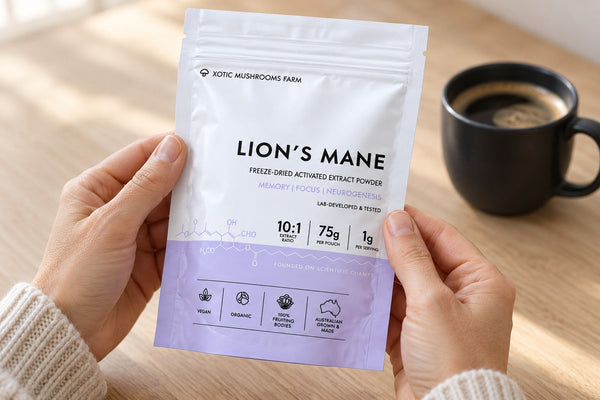
A good Lion's Mane label tells you the part of the mushroom used, the extract ratio, tested beta-glucan content, what else is in the product and where it was grown.
Fruiting body or mycelium
The fruiting body is the mushroom itself. Some products use mycelium grown on grain, which can carry a lot of starch from the grain. Look for a label that clearly says 100% fruiting body, or ask the seller directly.
Extract ratio
A ratio such as 10:1 indicates how much raw mushroom went into the finished extract. It is useful context, but on its own it does not prove quality, so read it alongside tested compound levels.
Tested beta-glucans
Beta-glucans are the polysaccharides most often measured in mushroom extracts. A tested figure from a named laboratory is far more meaningful than a vague claim about total polysaccharides.
Fillers and additives
Check for starch, maltodextrin, grain or flow agents. A pure extract powder should list Lion's Mane and nothing else, unless a blend is clearly disclosed.
Where it was grown
Country of origin tells you about supply chain length and traceability. Australian food labelling rules require origin information, which is explained by Food Standards Australia New Zealand.
How to Check Testing and Quality Claims
The most reliable way to check a Lion's Mane product is to ask for a certificate of analysis from a named, independent laboratory and read what was actually tested.
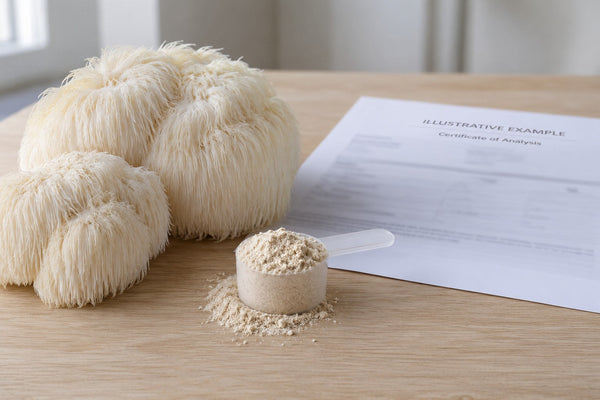
A certificate of analysis, or COA, lists the tests run on a specific sample, the method and the result. Look for the laboratory name, the report number and the date. Useful tests include beta-glucans, heavy metals and microbial checks such as E. coli.
As an example of what disclosure can look like, our specifications and testing page lists results from Symbio Laboratories, AEGIC, the National Measurement Institute and RMIT University researchers. Symbio (S2162602 [R01], 13 May 2026) measured 32.2% beta-glucans in the tested extract powder blend with 1% BioPerine, a sample-specific result rather than a guarantee for every finished product, and an earlier AEGIC test found 24.5 g/100 g in a historical sample. We have not yet tested for pesticides, and we say so.
Remember that any result applies to the sample tested, not to every batch ever made. A seller who explains that limitation clearly is usually being more honest than one quoting a single headline number with no source.
Is Lion's Mane Legal in Australia?
Yes, Lion's Mane (Hericium erinaceus) is a culinary mushroom that is legal to grow, sell and eat in Australia.
It is sold as fresh produce and as a food powder. Products marketed with therapeutic claims fall under the Therapeutic Goods Administration, and medicines supplied that way need to be included in the Australian Register of Therapeutic Goods.
For shoppers, the practical point is simple. Be wary of any product that promises to treat or cure a condition. Responsible sellers describe Lion's Mane in careful terms and focus on how the product is made rather than bold health promises.
What Lion's Mane Is Traditionally Used For
Lion's Mane has a long history in East Asian cooking and traditional practice, and today it is often researched for its potential role in cognitive wellbeing.
Researchers have studied compounds in the fruiting body, including hericenones and beta-glucans, and Lion's Mane is commonly associated with focus and general wellbeing routines. Much of the research is still early, so it is sensible to treat it as a food-based ingredient that may support a balanced routine rather than a quick fix.
If you take medication, are managing a health condition or have a mushroom allergy, speak with your doctor or pharmacist before adding it to your routine.
Buying for a Brand or Business?

If you are buying for a supplement brand, cafe or manufacturer, the checks shift from the retail label to specifications, COAs, minimum order quantities and samples.
Business buyers should request a full specification sheet, the latest COA, and clarity on extract ratio, extraction method and fruiting body content. You will also want to confirm minimum order quantities, packaging sizes and whether a sample is available for formulation trials. We supply bulk extract in 1 kg and 5 kg packs, and our white label Lion's Mane supply page explains the process and includes an enquiry form.
The Buying Lion's Mane in Australia Series
This pillar guide is the starting point for a short series covering each part of the buying decision in more detail.
- Grown here vs imported: how Australian grown Lion's Mane compares with imported products on traceability, testing and freshness.
- Choosing a powder: how to tell a good Lion's Mane powder from a weak one.
- Buyer's checklist: a criteria-based checklist to assess any Lion's Mane supplement sold in Australia.
For background on the farm itself, our farm and process page shows how our Lion's Mane is grown in Thomastown, Victoria on Tasmanian oak sawdust and Australian soya husk, freeze-dried at minus 82 °C and extracted with hot water and ethanol.
Conclusion
The best Lion's Mane in Australia is the one that tells you exactly what is inside: fruiting body, a clear ratio, tested beta-glucans and where it was grown. Try our Lion's Mane extract powder or Lion's Mane capsules. Brands can enquire about bulk and white label supply.
FAQs
Is Lion's Mane legal in Australia?
Yes. Lion's Mane is a culinary mushroom that is legal to grow, sell and eat in Australia, and it is sold fresh, dried, as powder and in capsules. Products that make therapeutic claims fall under the Therapeutic Goods Administration, so be cautious of any listing that promises to treat or cure a health condition.
Is Australian grown Lion's Mane better than imported?
Not automatically, but Australian grown Lion's Mane usually offers a shorter, more traceable supply chain and easier access to local testing. The better product is the one with fruiting body content, a clear extract ratio and independent lab results you can read, wherever it was grown.
Should I buy Lion's Mane powder or capsules?
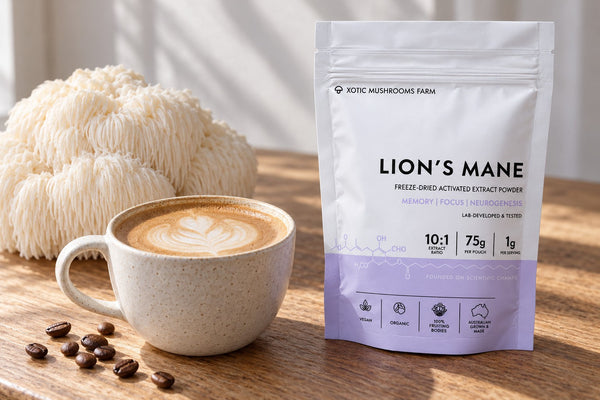
Choose powder if you want to mix Lion's Mane into coffee, lattes or smoothies and like adjusting your serve. Choose capsules if you prefer no taste and a pre-measured amount. Both can contain the same extract, so compare the ingredient list, extract ratio and testing rather than the format alone.
What does a 10:1 Lion's Mane extract mean?
A 10:1 ratio means roughly ten parts of raw mushroom went into one part of finished extract. Our fruiting bodies are harvested, freeze-dried and processed into a 10:1 extract. The ratio is helpful context, but tested beta-glucan content gives a clearer picture of what is in the product.
Does Lion's Mane have side effects?
Lion's Mane is a food mushroom and is generally well tolerated, though some people report mild digestive discomfort, and anyone with a mushroom allergy should avoid it. If you take medication, are pregnant or are managing a health condition, speak with your doctor or pharmacist before adding it to your routine.
How should I store Lion's Mane powder?
Keep Lion's Mane powder sealed in its pouch, in a cool, dry place away from direct sunlight and humidity. Moisture is the main cause of clumping, so use a dry spoon and close the pouch firmly after each use. Capsules should be stored the same way, with the lid tightly closed.
Source Lion’s Mane extract powder at scale
Australian-grown 10:1 fruiting body extract in 1 kg and 5 kg bags, with named-lab testing and white label supply for growing brands.
Request a sample or quote
Related articles
 7 October 2026
Best Mushroom Coffee in Australia: What to Look For on the LabelLooking for the best mushroom coffee in Australia? Use this label checklist to compare mushroom type, extract ratio,...
7 October 2026
Best Mushroom Coffee in Australia: What to Look For on the LabelLooking for the best mushroom coffee in Australia? Use this label checklist to compare mushroom type, extract ratio,...
 7 October 2026
Mushroom Extract in Australia: What Buyers Should CheckBuying mushroom extract in Australia? Learn how to check the extract ratio, fruiting body source, beta-glucans, extraction method,...
7 October 2026
Mushroom Extract in Australia: What Buyers Should CheckBuying mushroom extract in Australia? Learn how to check the extract ratio, fruiting body source, beta-glucans, extraction method,...
 7 October 2026
Mushroom Coffee in Australia: What It Is and How to ChooseA clear guide to mushroom coffee in Australia: what it is, which mushrooms are used, what to check...
7 October 2026
Mushroom Coffee in Australia: What It Is and How to ChooseA clear guide to mushroom coffee in Australia: what it is, which mushrooms are used, what to check...
Get farm and supply updates
New batches, lab results and bulk pricing, a few times a year.