Lion's Mane Mushroom Australia: Grown Here vs Imported

Introduction
If you are shopping for Lion's Mane mushroom in Australia, one of the first choices you will face is origin. Some products are grown and extracted here, while many others are imported, often from large overseas producers. Neither label guarantees quality on its own. This guide compares Australian grown and imported Lion's Mane on the things that affect your purchase: traceability, testing, freshness, labelling and value per serve. It also covers what changes when you are buying in bulk for a brand or business.
Is Australian Grown Lion's Mane Better Than Imported?
Australian grown Lion's Mane is not automatically better than imported, but it usually makes traceability and testing easier to verify, which is what matters most when you buy.
Quality comes from the mushroom itself, how it is processed and how honestly the product is described. A well-documented imported extract can be a sound purchase, and a vague local product can be a poor one.
Where local production tends to help is visibility. When the farm, drying and extraction happen in one country, there are fewer handovers between the mushroom and the pouch, and it is simpler to ask direct questions of the people who made it. If you want the story behind why origin matters to us, our post on Australian grown Lion's Mane covers it. This article stays focused on the buying decision.
Grown Here vs Imported at a Glance

The main differences between local and imported Lion's Mane are supply chain length, how easy testing is to check and how much detail the seller can give you.
| Criteria | Australian grown | Imported |
|---|---|---|
| Traceability | Usually farm to pouch in one country | Often several handovers between grower, extractor and brand |
| Testing access | Local labs, reports easier to request | Overseas COAs, sometimes supplier-issued only |
| Freshness | Shorter transit from production to shelf | Longer shipping and storage times |
| Part used | Varies, check the label | Varies, mycelium on grain is more common in some markets |
| Price | Often higher per gram | Often lower per gram |
| Questions answered | Can often speak to the grower | Depends on the brand's supplier relationship |
Use the table as a starting point, not a verdict. The checks in the next sections apply to every product, wherever it comes from.
Traceability and Labelling
Good traceability means you can follow a Lion's Mane product from where it was grown to the pouch in your hand, and the label is your first clue.
Food sold in Australia must carry country of origin information, and Food Standards Australia New Zealand explains how those labels work. Be aware that "packed in Australia" or "made from imported ingredients" is not the same as grown here.
Beyond origin, look for the part of the mushroom used, the extract ratio and the extraction method. Our own extract, for example, is grown in Thomastown, Victoria, freeze-dried at minus 82 °C and extracted with hot water and ethanol at a 10:1 ratio. If a seller cannot tell you these basics, treat that as a gap in the product, not a minor detail.
Testing: What Each Option Can Show You
Whether local or imported, the best evidence of quality is a certificate of analysis from a named independent laboratory that you can actually read.
Ask for the laboratory name, report number, date and the tests run. Beta-glucans, heavy metals and microbial checks are the most useful for shoppers. A COA issued only by the overseas supplier, with no third-party lab named, gives less assurance than an independent report.
Our specifications and testing page lists reports from Symbio Laboratories, AEGIC, the National Measurement Institute and RMIT University researchers, including 32.2% beta-glucans in the tested extract powder blend with 1% BioPerine (Symbio S2162602 [R01], 13 May 2026). This is a sample-specific result, not a guarantee for every finished product. Pesticide testing has not been done yet. Results apply to the sample tested, and you can learn how to check Lion's Mane lab results for any brand.
Price and Value per Serve
Compare Lion's Mane on cost per serve and on what each serve contains, not on the pouch price alone.
Imported products are often cheaper per gram, partly because of scale and partly because some use whole mushroom powder or mycelium rather than a concentrated fruiting body extract. A lower price can simply reflect a different product.
To compare fairly, divide the price in AUD by the number of serves on the label, then check what a serve contains. Our powder label lists a 1 g serve, giving 75 serves in a 75 g pouch, and our capsules list two 300 mg capsules per serve. A product with a larger serve size may look cheaper per gram but cost more per day. Free shipping on Australian orders over A$100 can also change the real cost of a Lion's Mane extract powder order.
Buying for a Brand or Business?
For brands, cafes and manufacturers, origin becomes a supply question: continuity, documentation and how quickly you can get samples and answers.
Business buyers should ask for a specification sheet, current COA, minimum order quantity and sample availability, and should check whether the supplier can keep batches consistent over time. Local supply can shorten lead time conversations, but documentation matters more than geography. Our white label Lion's Mane page covers bulk 1 kg and 5 kg supply and has an enquiry form.
Conclusion
Australian grown and imported Lion's Mane can both be worth buying, but local production usually makes it easier to see what you are getting. Check origin, part used, extract ratio and independent testing before you buy. Shop our Lion's Mane extract powder and capsules, or enquire about bulk supply for your brand.
FAQs
Is imported Lion's Mane safe to buy?
Imported Lion's Mane can be a reasonable purchase when it is clearly labelled and backed by an independent certificate of analysis. Look for heavy metal and microbial testing from a named laboratory. If the seller cannot provide testing or explain the part of the mushroom used, choose a product with clearer documentation.
How can I tell where Lion's Mane was grown?
Start with the country of origin statement on the label, then check the seller's website for where the mushrooms are grown and extracted. Phrases such as "packed in Australia" do not mean grown here. If it is unclear, ask the seller directly where the farm and extraction facility are.
Why is Australian grown Lion's Mane often more expensive?
Australian grown Lion's Mane usually costs more because of local labour, energy and smaller production scale. Products made from concentrated fruiting body extract also use more raw mushroom per gram. Comparing price per serve, and what each serve contains, gives a fairer picture than comparing pouch prices.
Is fresh Lion's Mane grown in Australia?
Yes. Several Australian growers produce fresh Lion's Mane, which is sold through specialty growers, some farmers' markets and online. Fresh mushrooms have a short shelf life, so most people who want a daily routine choose a dried extract powder or capsules made from Australian grown fruiting bodies.
Does origin change how Lion's Mane tastes?
Growing substrate, drying and extraction influence taste more than country alone. Extract powders generally have a mild, earthy flavour that blends easily into coffee, cacao or smoothies. If taste matters, check how the product is processed and consider capsules, which avoid the flavour altogether.
Can imported Lion's Mane be made from the fruiting body?
Yes. Imported products can be fruiting body extracts, but some are made from mycelium grown on grain, which may carry starch from the grain. Check the label for a clear statement such as 100% fruiting body and ask for testing if the label is vague.
Source Lion’s Mane extract powder at scale
Australian-grown 10:1 fruiting body extract in 1 kg and 5 kg bags, with named-lab testing and white label supply for growing brands.
Request a sample or quote
Related articles
 7 October 2026
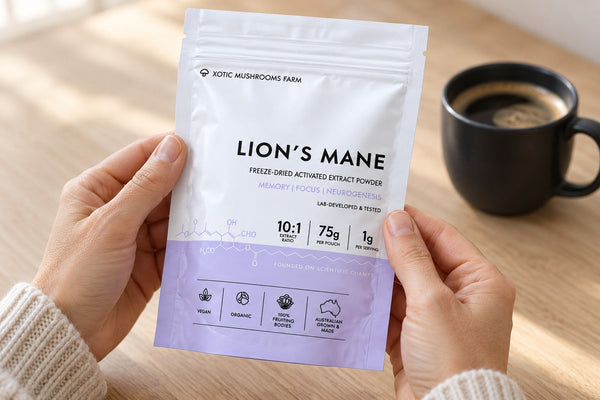
Best Mushroom Coffee in Australia: What to Look For on the LabelLooking for the best mushroom coffee in Australia? Use this label checklist to compare mushroom type, extract ratio,...
7 October 2026
Best Mushroom Coffee in Australia: What to Look For on the LabelLooking for the best mushroom coffee in Australia? Use this label checklist to compare mushroom type, extract ratio,...
 7 October 2026
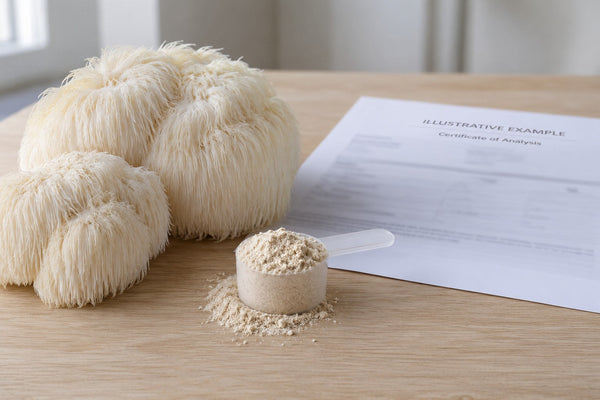
Mushroom Extract in Australia: What Buyers Should CheckBuying mushroom extract in Australia? Learn how to check the extract ratio, fruiting body source, beta-glucans, extraction method,...
7 October 2026
Mushroom Extract in Australia: What Buyers Should CheckBuying mushroom extract in Australia? Learn how to check the extract ratio, fruiting body source, beta-glucans, extraction method,...
 7 October 2026
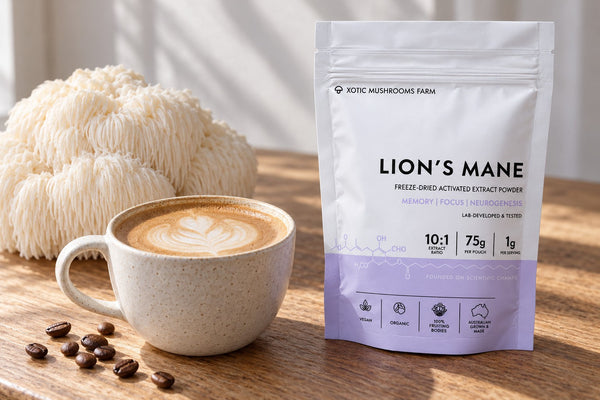
Mushroom Coffee in Australia: What It Is and How to ChooseA clear guide to mushroom coffee in Australia: what it is, which mushrooms are used, what to check...
7 October 2026
Mushroom Coffee in Australia: What It Is and How to ChooseA clear guide to mushroom coffee in Australia: what it is, which mushrooms are used, what to check...
Get farm and supply updates
New batches, lab results and bulk pricing, a few times a year.