Lion's Mane at the Chemist vs Online: What's the Difference?

Introduction
If you have searched for lions mane chemist warehouse, you are probably weighing up convenience against choice. Pharmacies now stock Lion's Mane capsules and mushroom blends, while online stores and growers sell extract powders and capsules direct. Both channels can work well. This guide compares them on the criteria that matter, not on brands: what is in the product, how much information you get, where it was grown, testing, freshness and value per serve, so you can choose with confidence.
Can You Buy Lion's Mane at Chemist Warehouse?
Yes, Lion's Mane products are sold through Australian pharmacy chains, including Chemist Warehouse, both in store and on their websites. The range on a pharmacy shelf usually leans towards capsules and multi mushroom blends from established supplement brands, with the odd powder or liquid alongside.
The main advantage is convenience. You can pick a bottle up with your weekly shop, ask a pharmacist a general question, and return to a store you already know. Some capsule products on pharmacy shelves are listed complementary medicines that carry an AUST L number on the label, which means they appear on the Australian Register of Therapeutic Goods. Others are sold as foods, so it pays to read the pack.
The trade off is range and depth of information. Shelf space is limited, so a store may carry only a handful of Lion's Mane options, and the packaging has to fit a lot onto a small label. Detail such as the extract ratio, whether the product uses fruiting body or mycelium, and where the mushrooms were grown is not always printed.
None of this makes pharmacy products better or worse. It simply means the shopper has to do a little more checking at the shelf, which is where knowing the right questions helps.
Pharmacy Shelf vs Online: How the Channels Compare

The biggest differences between buying Lion's Mane at a chemist and buying online are range, the amount of product information you can access, and how close you are to the grower. Price per serve and freshness vary product by product rather than channel by channel.
| Criteria | Pharmacy shelf | Online, direct from a grower |
|---|---|---|
| Convenience | Buy today, in person | Delivered; free shipping thresholds often apply |
| Range of formats | Mostly capsules and blends | Powders, capsules and multiple pack sizes |
| Product information | Limited to the label | Full product pages, specifications and FAQs |
| Origin and traceability | Varies; often imported ingredients | Grower can state farm, substrate and process |
| Testing documents | Usually not shown at point of sale | Some growers publish lab results or share a COA |
| Advice | General pharmacist advice in person | Direct answers from the producer by email |
Online shopping covers a wide spread, from marketplaces to supplement brands to growers who sell their own harvest. The comparison above focuses on the grower direct option because it sits furthest from the pharmacy model.
For price, compare the cost per daily serve, not the pack price. A capsule bottle and a powder pouch can look similar in dollars but differ widely in serves.
What to Check on the Label, Wherever You Buy
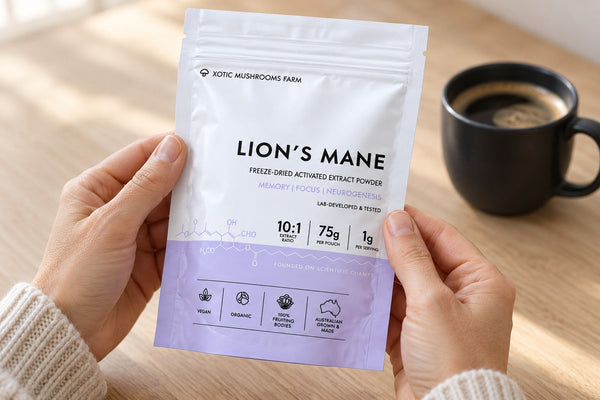
Whether you buy at a chemist or online, the label should tell you the form, the part of the mushroom used, the extract ratio if it is an extract, and the serving size. If any of these are missing, ask the seller before you buy.
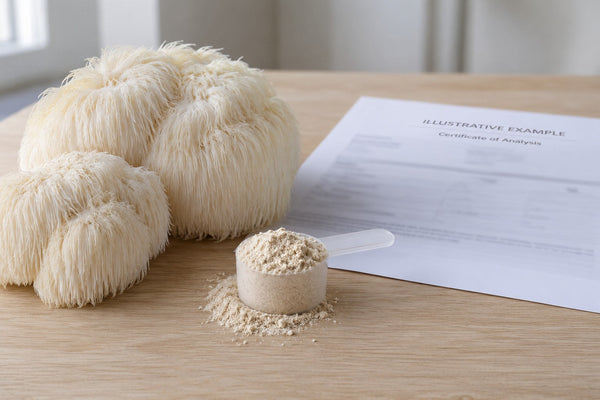
Form matters because whole mushroom powder and extract powder are different products. An extract has been processed to concentrate compounds such as beta-glucans, while a whole powder is simply dried and milled mushroom. Our guide to Lion's Mane extract vs whole mushroom powder explains the difference in more detail.
The part of the mushroom matters too. Fruiting body products use the mushroom itself, while mycelium products are often grown on grain, which can add starch. Look for the words "fruiting body" and a stated ratio such as 10:1.
For a fuller shopping checklist covering origin, certifications and price, see our pillar guide, Lion's Mane in Australia: Where to Buy and What to Look For.
When Buying Direct From a Grower Makes Sense

Buying direct from a grower makes sense when you want to know exactly where your Lion's Mane came from, how it was processed and how it was tested. Shorter supply chains mean fewer hands between the farm and your cupboard.
At Xotic Mushrooms, for example, our Lion's Mane is grown in Thomastown, Victoria, on Tasmanian oak hardwood sawdust and Australian soya husk. The fruiting bodies are freeze dried at minus 82 °C, then put through a hot water and ethanol dual extraction at a 10:1 ratio. There is no starch, mycelium, grain or filler. You can see more on our farm and process.
Testing is the other reason. Our specifications and testing page shows a Symbio Laboratories result of 32.2% beta-glucans in the tested extract powder blend with 1% BioPerine (Symbio S2162602 [R01], 13 May 2026), a sample-specific result rather than a guarantee for every finished product, along with earlier AEGIC and NMI results and RMIT University microbial testing. Results apply to the samples tested.
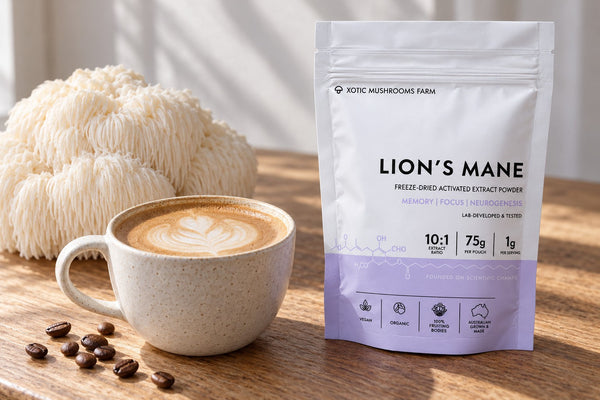
Format choice is wider too. Our Lion's Mane extract powder comes in 50 g to 1.2 kg pouches, and Lion's Mane capsules come in 60 and 120 packs.
Buying for a Brand or Business?
Brands, cafes and manufacturers need more than a retail label. Ask for a full specification, a current COA, the MOQ and a sample before committing. We supply 1 kg and 5 kg bulk packs and white label Lion's Mane for Australian brands.
Conclusion
Chemist and online channels both sell Lion's Mane, so the right choice depends on what you value. Pharmacies win on convenience; buying direct gives you more detail on origin, extraction and testing. Read the label either way. If you want traceable, Australian grown extract, explore our Lion's Mane powder and capsules. Brands can ask about white label supply.
FAQs
Is Lion's Mane available at Chemist Warehouse?
Yes. Lion's Mane capsules and mushroom blends are sold through Chemist Warehouse and other Australian pharmacies, in store and online. Ranges vary by store and change over time, so check the retailer's website for current stock. Read the label for the form, the part of the mushroom used and the serving size before you buy.
Is Lion's Mane from a pharmacy better than buying online?
Not automatically. Pharmacy and online products can both be good quality. The difference is usually range and information: online sellers and growers often publish fuller specifications, origin details and lab results, while pharmacies offer convenience and in person general advice. Compare products on extract type, fruiting body content, testing and cost per serve rather than on channel.
What is the downside of Lion's Mane?
Lion's Mane is a culinary mushroom that is generally well tolerated, but some people report mild digestive discomfort, and anyone with a mushroom allergy should avoid it. Quality also varies between products. If you take medication, are pregnant or breastfeeding, or have a health condition, speak to your GP or pharmacist before using any supplement.
Who should check with a doctor before taking Lion's Mane?
Anyone who is pregnant or breastfeeding, takes prescription medication, has a mushroom allergy or manages an ongoing health condition should speak with a GP or pharmacist first. This is standard advice for any supplement and helps rule out interactions. Follow the serving size on the label and do not exceed it.
Are Lion's Mane capsules or powder better value?
Powder usually works out cheaper per serve, while capsules trade some value for convenience. Compare cost per daily serve rather than pack price. For example, our powder label serving is 1 g, giving 75 serves in a 75 g pouch, while our capsule serve is two 300 mg capsules. Choose the format you will use consistently.
How can I tell if a Lion's Mane product has been tested?
Look for a published certificate of analysis (COA) or lab results on the seller's website, or email them and ask. A useful COA names the laboratory, the date and the results, such as beta-glucan content, heavy metals and microbial testing. Remember that results apply to the specific sample tested, so newer reports are more relevant.
Source Lion’s Mane extract powder at scale
Australian-grown 10:1 fruiting body extract in 1 kg and 5 kg bags, with named-lab testing and white label supply for growing brands.
Request a sample or quote
Related articles
 7 October 2026
Best Mushroom Coffee in Australia: What to Look For on the LabelLooking for the best mushroom coffee in Australia? Use this label checklist to compare mushroom type, extract ratio,...
7 October 2026
Best Mushroom Coffee in Australia: What to Look For on the LabelLooking for the best mushroom coffee in Australia? Use this label checklist to compare mushroom type, extract ratio,...
 7 October 2026
Mushroom Extract in Australia: What Buyers Should CheckBuying mushroom extract in Australia? Learn how to check the extract ratio, fruiting body source, beta-glucans, extraction method,...
7 October 2026
Mushroom Extract in Australia: What Buyers Should CheckBuying mushroom extract in Australia? Learn how to check the extract ratio, fruiting body source, beta-glucans, extraction method,...
 7 October 2026
Mushroom Coffee in Australia: What It Is and How to ChooseA clear guide to mushroom coffee in Australia: what it is, which mushrooms are used, what to check...
7 October 2026
Mushroom Coffee in Australia: What It Is and How to ChooseA clear guide to mushroom coffee in Australia: what it is, which mushrooms are used, what to check...
Get farm and supply updates
New batches, lab results and bulk pricing, a few times a year.