
Nootropic Mushrooms: What They Are and Where Lion's Mane Fits

Nootropic mushrooms are everywhere, from coffee blends to gummies, and the marketing around them can be loud. Much of it promises more than the science currently shows.
This guide explains what the term means, which species sit in the category, what research says so far and how to read a label. Xotic Mushrooms grows Lion's Mane in Australia and ships its extract powder and capsules internationally, so we focus on where it fits.
What Are Nootropic Mushrooms?
Nootropic mushrooms are culinary and functional mushrooms, such as Lion's Mane, that are marketed and often researched for their possible role in brain and mental wellbeing.
"Nootropic" is an informal word for substances people take with thinking, focus or mood in mind. It is not a regulated category. A product can call itself nootropic without any agency reviewing that description, so the word tells you about positioning rather than proven effect.
The mushrooms in this group are non-psychedelic. They are edible or traditionally used species, eaten as food in parts of Asia for centuries, and they contain no psilocybin. Lion's Mane, for example, will not make you high; we cover that question in detail in whether Lion's Mane is psychedelic.
Interest in the category has grown quickly. Shoppers search for mushroom gummies, mushroom coffee and capsules, and brands have responded with a wave of products. That growth is exactly why it pays to understand what you are buying.
Nootropic vs Adaptogenic Mushrooms
"Nootropic" points to mental wellbeing, while "adaptogenic" points to how the body copes with everyday stress, and many mushrooms are marketed under both labels.
Both are informal, marketing-led terms. Adaptogen describes a herb or mushroom traditionally used to support the body's balance under stress, a concept from herbal tradition rather than modern regulation. Reishi and cordyceps are often sold as adaptogens; Lion's Mane is more often sold as a nootropic.
In practice the line is blurry. A single blend may combine Lion's Mane, reishi and cordyceps and use both words on the pouch. When you compare products, focus less on the label category and more on the species, the part of the mushroom used and whether the brand shows test results.
The Main Mushrooms in the Category
Five species appear most often in nootropic and functional mushroom products: Lion's Mane, cordyceps, reishi, chaga and turkey tail.

| Mushroom | Latin name | How it is usually positioned | Traditional use |
|---|---|---|---|
| Lion's Mane | Hericium erinaceus | Nootropic, often researched for brain and nerve health | Culinary and traditional use in East Asia |
| Cordyceps | Cordyceps militaris / sinensis | Energy and performance positioning | Traditional Chinese and Tibetan use |
| Reishi | Ganoderma lingzhi / lucidum | Adaptogen, calm and evening routines | Long traditional use in China and Japan |
| Chaga | Inonotus obliquus | General wellness, often in teas | Folk use in Russia and northern Europe |
| Turkey tail | Trametes versicolor | General wellness, beta-glucan focus | Traditional use in Asia |
This table describes how each species is commonly marketed and traditionally used, not proven effects. For a closer look at three of them, see how Lion's Mane compares with reishi and cordyceps.
Why Lion's Mane Leads the Group
Of the five, Lion's Mane is the mushroom most closely tied to the word nootropic. It has been studied in a handful of small human trials and in many laboratory studies, and it is also a well-known culinary mushroom, which makes it easy to use daily.
What Does the Research Actually Say?
Research on nootropic mushrooms is promising in places but early, and most human trials so far have been small and short, so the evidence remains limited.
Much of the work on these species comes from cell and animal studies. Those can suggest how a compound might behave, but they do not show what happens when a person takes a mushroom supplement. Human trials are fewer, and they often involve dozens of participants rather than thousands.
Lion's Mane is a useful example. A 2023 pilot trial in healthy young adults gave 1.8 g a day for 28 days and compared it with a placebo. The authors reported some tentative findings in a small pilot, but they stressed that the sample was small and that larger trials are needed.
That caution is the honest summary for the category. Lion's Mane and its relatives are often researched for their role in brain and mental wellbeing, and interest is growing, but no mushroom has been shown to reliably improve thinking in healthy people. Treat any product promising sharper memory or instant focus with healthy scepticism.
It also matters that results from one product cannot be applied to another. Studies use specific preparations, doses and parts of the mushroom. A trial of one extract says little about a different powder made from mycelium grown on grain.
Where Lion's Mane Fits
Lion's Mane sits at the centre of the nootropic mushroom category because it is the species most often researched in this area and the one most commonly sold for it.

Researchers have been particularly interested in two groups of compounds found in Lion's Mane, called hericenones and erinacines, along with the mushroom's beta-glucans. These compounds are studied in laboratory settings, and they help explain why the species attracts attention, though lab interest is not the same as a proven effect in people.
For shoppers, the practical questions are which part of the mushroom is used and how it is processed. A fruiting body extract is made from the mushroom itself, concentrated with water, alcohol or both. The basics of Lion's Mane extract explain those differences in more depth.
Xotic's Lion's Mane is a 100% fruiting body extract grown in Thomastown, Victoria, on Tasmanian oak hardwood sawdust and Australian soya husk. The fruiting bodies are harvested, freeze-dried and processed into a 10:1 extract using hot water and ethanol dual extraction, with no added starch, grain, mycelium or fillers.
It is also a single-ingredient product. Lion's Mane is not naturally caffeinated and our extract contains no coffee or caffeine; mushroom coffee blends get their caffeine from the coffee in them.
How to Choose a Mushroom Supplement Safely
Choose products that name the species and part used, list every ingredient and share independent lab results, and avoid anything vague about what is inside.
- Species and Latin name: "Lion's Mane (Hericium erinaceus)" is clearer than "mushroom complex".
- Part used: fruiting body, mycelium, or both, stated on the label.
- Extract details: an extract ratio and extraction method if it is an extract.
- Full ingredient list: watch for grain, fillers, sugars and undeclared blends.
- Lab results: beta-glucans, heavy metals and microbial testing from an independent lab.
- Careful claims: wording such as "may support" rather than promises to fix memory or mood.
In the US, the FDA explains that it does not approve dietary supplements before sale, so the responsibility for safety and honest labelling sits with the brand. That makes published testing more valuable. You can see how we present our own Lion's Mane lab results.
A Warning About Mislabelled "Nootropic" Gummies
Not every product sold as a nootropic mushroom is what it claims. US health officials have reported undisclosed psilocybin in gummies labelled as mushroom nootropics, some marketed as Amanita muscaria, and several people needed emergency care. Buy from brands that name every ingredient and test their products.
Formats: Powder, Capsules and Gummies
Nootropic mushrooms are sold mainly as powders, capsules and gummies, and the format changes convenience, cost and how much of the mushroom you get per serve.
Powders are flexible. They stir into coffee, tea, smoothies or a latte, and they usually cost the least per serve. Capsules suit people who want a fixed amount with no taste. Gummies are convenient but often contain sugar and less mushroom per piece, so check the label closely.
Our Lion's Mane extract powder lists a 1 g serve, and our capsules list 2 x 300 mg per serve. Both contain the same extract, and the powder is cheaper per serve. Follow the label serving, and talk to your doctor before starting any supplement if you are pregnant, take medication or have a mushroom allergy. Our notes on Lion's Mane side effects cover the questions people ask most.
Building a Nootropic Mushroom Product for Your Brand?
Brands entering the category need documented specifications and compliant claims as much as a good ingredient.
Before you commit to a supplier, ask for a specification sheet, a recent certificate of analysis, minimum order quantities and samples. Check whether the extract is fruiting body or mycelium, how it is extracted and whether heavy metal and microbial testing is current. Keep packaging language to "may support" or "often researched for", and avoid any treatment claim.
Xotic supplies white and private label Lion's Mane for brands, cafés and retailers. White label means our established powder or capsules under your brand. Private label means your own blend, formulation or packaging, which usually involves higher MOQs and longer lead times. Bulk extract is also available in 1 kg and 5 kg packs.
Final Thoughts
Nootropic mushrooms are a broad, marketing-led category, and the human research behind them is still small and early.
Choose a clearly labelled, tested product and keep expectations realistic. Our Lion's Mane extract powder and capsules are a simple place to start. Brands can ask about white label supply.
FAQs
1. What does nootropic mean?
Nootropic is an informal term for substances people take with thinking, focus or mood in mind. It is not a regulated category, so any product can use the word. For mushrooms, it usually describes species such as Lion's Mane that are often researched for their possible role in brain and mental wellbeing.
2. Which mushroom is most researched for brain health?
Lion's Mane (Hericium erinaceus) is the mushroom most often researched in this area. Its hericenones, erinacines and beta-glucans have been studied in the lab, and it has been tested in a few small human trials. The evidence is still limited, so it is best described as often researched for, rather than proven.
3. Is there a downside to taking Lion's Mane?
Lion's Mane is a culinary mushroom and is generally well tolerated, though some people report mild stomach upset, and anyone with a mushroom allergy should avoid it. Follow the label serving and speak with your doctor first if you are pregnant, breastfeeding, take medication or have a health condition.
4. Do adaptogenic mushrooms work?
Adaptogenic mushrooms such as reishi and cordyceps are traditionally used to support the body's balance under stress, and they are often researched for that role. Human studies are mostly small and varied, so the evidence is limited. Choose tested products and treat them as part of a routine rather than a fix.
5. Are nootropic mushrooms psychedelic?
Genuine nootropic mushrooms such as Lion's Mane, cordyceps and reishi are not psychedelic and contain no psilocybin. However, US health officials have found undisclosed psilocybin in some gummies sold as mushroom nootropics, so buy from brands that list every ingredient and publish independent lab testing.
6. Do nootropic mushrooms make you feel different?
Most people should not expect an immediate feeling from Lion's Mane or similar mushrooms, which are not stimulants and contain no caffeine. Small trials have looked at use over several weeks, with limited and early results. If a mushroom product causes a strong effect, check its ingredients carefully.
Source Lion’s Mane extract powder at scale
Australian-grown 10:1 fruiting body extract in 1 kg and 5 kg bags, with named-lab testing and white label supply for growing brands.
Request a sample or quote
Related articles
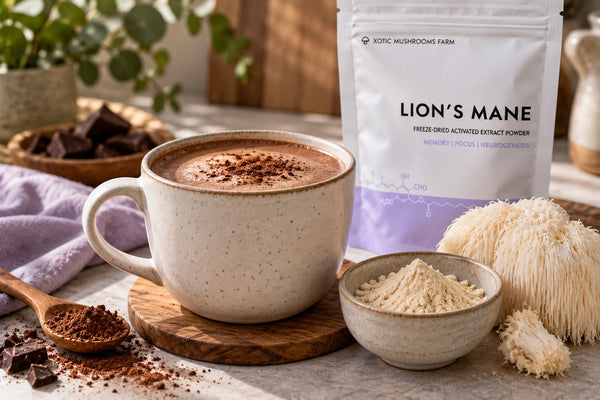 17 October 2026
Mushroom Hot Chocolate: What It Is and How to Choose OneMushroom hot chocolate blends cocoa with a functional mushroom extract. Learn what is in it, which label details...
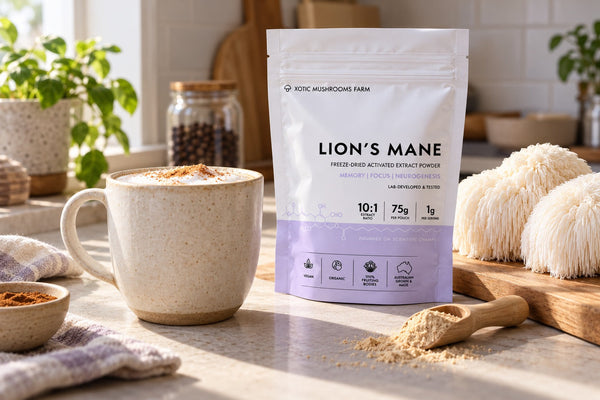 17 October 2026
When to Take Lion's Mane: Morning, Afternoon or Night?When to take Lion's Mane comes down to routine. Compare morning, afternoon and night, with coffee or food,...
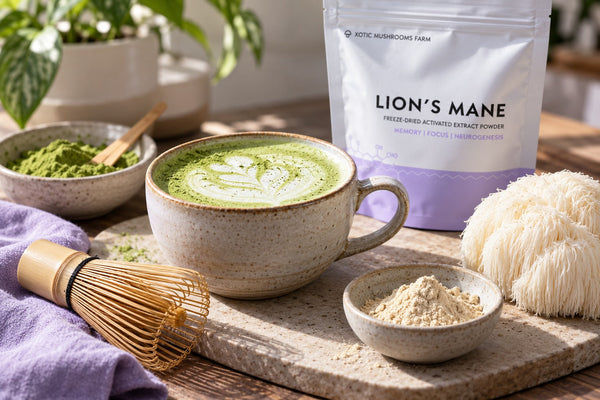 17 October 2026
Mushroom Matcha: What It Is and How to Make ItMushroom matcha blends matcha green tea with a mushroom extract such as Lion's Mane. Learn what it is,...
Get farm and supply updates
New batches, lab results and bulk pricing, a few times a year.
More from Resources
- Does Mushroom Coffee Have Caffeine?
- What's Actually in Mushroom Coffee? Ingredients Explained
- How Much Lion's Mane Powder per Serve? Reading the Label
- Mycelium Powder vs Fruiting Body Powder: What Shoppers Should Know
- Mushroom Tea: What It Is and How to Make It (the Non-Psychedelic Kind)
- Best Mushroom Coffee in Australia: What to Look For on the Label