
How Much Lion's Mane Is Too Much?

If you are asking how much lion's mane is too much, the honest answer is that no official upper limit has been set for this mushroom as a supplement.
What exists instead is the serving on your product label, a short list of reported side effects, and some groups who should check with a professional first.
This explainer covers all three, without telling you what to take, so you can follow the label and ask a GP or pharmacist with confidence.
Is There a Set Limit for How Much Lion's Mane Is Too Much?
There is no agreed maximum daily amount of lion's mane (Hericium erinaceus) set by a health authority, so "too much" is best judged against the label serving and your own health situation.
Lion's Mane is eaten as a culinary mushroom in many parts of the world, and it is sold as whole mushroom powders, extracts, capsules and blends. Each of these delivers a very different amount of mushroom material per gram, which is one reason a single universal number does not exist.
Human research is also limited. Studies have used different preparations, amounts and durations, often in small groups of healthy adults, and none were designed to find a safe upper limit. For example, a small 2023 double-blind pilot study gave 41 young adults a specific capsule product for 28 days. That tells you what one study used, not what anyone else should take.
Many websites publish milligram ranges "by goal". Those figures usually come from mixed product types and are not a substitute for the instructions on the product you actually bought.
Why the Label Serving Is Your Reference Point
The label serving is the amount the manufacturer has set for that specific product, so it is the only reliable starting point for how much is appropriate.
An extract is not the same as dried, ground mushroom. Xotic Mushrooms uses 100% Lion's Mane fruiting body, grown in Victoria, Australia, then harvested, freeze-dried and processed into a 10:1 extract with hot water and ethanol dual extraction. A gram of that extract is not interchangeable with a gram of a whole mushroom powder or a blended drink mix. Extraction concentrates the mushroom material, which is why labels differ so much.
Here is what our own labels state:
| Product | Label serving | What it contains |
|---|---|---|
| Lion's Mane extract powder | 1 g | 100% fruiting body extract, no fillers |
| Lion's Mane capsules | 2 x 300 mg capsules | The same extract as the powder |
We quote these servings for reference only. They are not a personal recommendation, and if you use another brand, its label applies instead. If you switch between our Lion's Mane extract powder and capsules, read each label rather than converting between them yourself.
What Side Effects Have Been Reported?

Reported side effects of lion's mane supplements are uncommon and mostly mild, with abdominal discomfort, nausea and skin rash noted in clinical study reports.
Memorial Sloan Kettering Cancer Center's About Herbs entry on lion's mane lists exactly those three effects. It also describes lion's mane as generally safe in food and tea, while advising people to talk with their healthcare providers before taking it as a supplement, since it can interact with some medications.
That is a neutral summary, not a guarantee. Evidence from small trials cannot rule out rarer reactions, and individual responses vary. If you notice anything unusual, the sensible step is to stop and speak with a GP or pharmacist.
Individual symptoms and what is known about each are covered in more detail under Lion's Mane side effects. This article stays focused on amounts and who should check first.
Who Should Check With a GP or Pharmacist First?
Anyone with a mushroom allergy, anyone taking regular medication, and anyone pregnant or breastfeeding should speak with a GP or pharmacist before using lion's mane.
- Allergies: lion's mane is a fungus, so people with known mushroom or mould sensitivities should be cautious, and anyone with a history of allergic reactions should ask first.
- Medications: MSKCC notes possible interactions with some medications. A pharmacist can check your specific prescriptions, including any for blood clotting or blood sugar.
- Pregnancy and breastfeeding: there is not enough safety research in these groups, so professional advice comes first.
- Upcoming surgery or ongoing health conditions: mention any supplement you take to your care team.
Whether lion's mane suits you in general is a wider question, and the broader evidence on whether Lion's Mane is safe is worth reading separately. The short version here is simple: the label tells you the serving, and a professional tells you whether it fits your situation.
How to Keep Your Intake Consistent
The simplest way to avoid taking more than intended is to stick with one product, measure the label serving accurately, and check every other product you use for lion's mane.
Overlap is a common reason people take more than they realise. Mushroom coffees, gummies and nootropic blends often contain lion's mane alongside other ingredients, so adding a standalone extract on top can double up without you noticing.
Measuring matters too. With a powder, use the scoop or a small kitchen scale rather than guessing with a teaspoon. Capsules make this easier, which is one reason some people prefer our Lion's Mane capsules. Simple mixing tips for using Lion's Mane extract powder help with accuracy too.
Finally, look at what has been tested. We publish our lab results and specifications, including beta-glucan, heavy metal and microbial testing on submitted samples, so you can see what is in the product. Xotic is Australian grown and ships its Lion's Mane extract powder and capsules internationally, including to the US.
Making a Mushroom Product for Your Brand or Café?
Businesses need more than a label serving. You will want a specification sheet, a COA for each batch, clear MOQs and samples to test in your own recipe. We supply white and private label Lion's Mane, from our established powder and capsules under your brand to your own formulation or packaging, plus bulk extract in 1 kg and 5 kg.
The Bottom Line on Lion's Mane Amounts
There is no official ceiling for lion's mane, so the label serving, a careful check of other products and professional advice are your best guides.
Shoppers can start with our Lion's Mane extract powder or capsules and follow the label. Brands can ask us about white label, private label or bulk supply.
FAQs
1. What happens if you take too much lion's mane?
There is no established threshold for too much lion's mane, and research on very high intakes is limited. Reported side effects in studies are mostly mild, such as abdominal discomfort, nausea or skin rash. If you have taken more than the label serving or feel unwell, stop using it and contact a GP, pharmacist or local poisons information service for advice.
2. Can you take lion's mane every day?
Some studies have given lion's mane daily for several weeks, but that does not mean daily use suits everyone. The safest approach is to follow the serving and directions on your product label and check with a GP or pharmacist, especially if you take medications, have allergies, or are pregnant or breastfeeding.
3. What should you not mix with lion's mane?
Memorial Sloan Kettering notes that lion's mane can interact with some medications. Because interactions depend on the specific drug, ask a pharmacist to review your prescriptions before starting. Also check other supplements and mushroom coffees you use, since many already contain lion's mane and combining them can mean taking more than intended.
4. Is lion's mane extract stronger than whole mushroom powder?
Extract and whole powder are made differently, so a gram of one is not equivalent to a gram of the other. Xotic's powder is a 10:1 fruiting body extract made with hot water and ethanol dual extraction. Because products differ, always follow the serving on the specific label rather than converting between products.
5. Does lion's mane give you a buzz?
Lion's mane is not a stimulant and is not naturally caffeinated, so it is not associated with a buzz. Xotic's products are a single-ingredient mushroom extract with no coffee or caffeine. Mushroom coffee blends that feel stimulating get their caffeine from the coffee they contain, not from the lion's mane.
6. Can I take lion's mane if I have a mushroom allergy?
Lion's mane is a fungus, so anyone with a known mushroom or mould allergy should be cautious and speak with a GP, allergist or pharmacist before trying it. Skin rash has been reported in clinical study summaries. If you notice any allergic symptoms after taking it, stop and seek medical advice promptly.
Source Lion’s Mane extract powder at scale
Australian-grown 10:1 fruiting body extract in 1 kg and 5 kg bags, with named-lab testing and white label supply for growing brands.
Request a sample or quote
Related articles
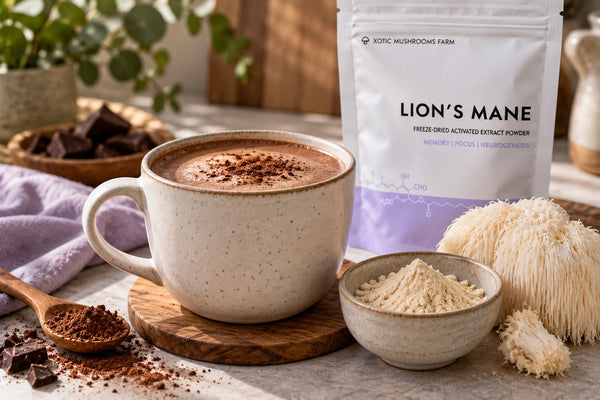 17 October 2026
Mushroom Hot Chocolate: What It Is and How to Choose OneMushroom hot chocolate blends cocoa with a functional mushroom extract. Learn what is in it, which label details...
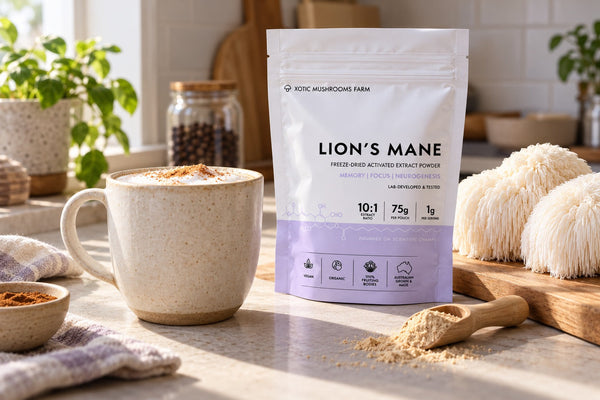 17 October 2026
When to Take Lion's Mane: Morning, Afternoon or Night?When to take Lion's Mane comes down to routine. Compare morning, afternoon and night, with coffee or food,...
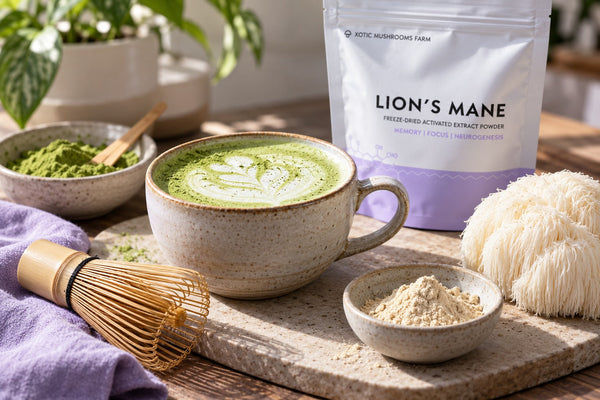 17 October 2026
Mushroom Matcha: What It Is and How to Make ItMushroom matcha blends matcha green tea with a mushroom extract such as Lion's Mane. Learn what it is,...
Get farm and supply updates
New batches, lab results and bulk pricing, a few times a year.
More from Resources
- Nootropic Mushrooms: What They Are and Where Lion's Mane Fits
- Does Mushroom Coffee Have Caffeine?
- What's Actually in Mushroom Coffee? Ingredients Explained
- How Much Lion's Mane Powder per Serve? Reading the Label
- Mycelium Powder vs Fruiting Body Powder: What Shoppers Should Know
- Mushroom Tea: What It Is and How to Make It (the Non-Psychedelic Kind)