
Why Lion’s Mane Is a Core Functional Mushroom Ingredient

Lion’s Mane is no longer a side ingredient. In cognitive, focus and daily wellness ranges it is now often the one the formula is built around, and the reasons are mostly practical: it extracts well, it holds a specification, and it can be documented properly.
We grow Lion’s Mane on our farm in Thomastown, Victoria, and turn the fruiting bodies into a 10:1 extract. This piece explains, from the grower’s side of the table, why the mushroom earns a “core” place in a formulation and what a brand should check before building a product on it.
What Makes a Functional Mushroom a “Core” Ingredient
A core ingredient is the one you can put at the centre of a range and trust across formats, batches and years. Novelty does not get it there. Predictability does.
In our experience, a core functional mushroom ingredient needs five things:
- A clear category role: buyers and shoppers already understand where it sits, so the positioning does not need inventing.
- Tolerance for extraction: it can be processed into a concentrated, repeatable extract without falling apart.
- Stability in storage and transport: the powder stays as specified from packing to the production line.
- Paperwork you can check: a spec sheet and dated lab reports that name the lab, the sample and the date.
- Format flexibility: it works in capsules, powders, sachets and drinks without a full reformulation each time.
Lion’s Mane ticks these boxes more often than most mushrooms we see. That is why it tends to anchor brain-focused and daily-use products rather than sitting at the bottom of the ingredient list.
Why Lion’s Mane Holds a Foundational Place in Formulation

Short answer: it behaves well at every stage a brand cares about. Here is how that breaks down.
1. A Clear Place in the Cognitive Category
Lion’s Mane is commonly associated with focus and mental clarity positioning. It does not compete for the energy, sleep or immune story, so it gives a range one clean message.
That matters when you are planning several SKUs. A capsule, a coffee blend and a powder can all carry Lion’s Mane at the centre without the range feeling muddled.
2. Research Context, Not Promises
Lion’s Mane has a long record of traditional use and is often researched for its compounds. We work with researchers at RMIT University’s School of Science, led by Dr Tien Huynh, on microscopy, compound profiling and microbial screening of our own powder.
None of that is a claim you can print on a label. Use wording such as “traditionally used for” or “often researched for”, and leave out therapeutic language and outcome promises. In Australia our product is sold as a food, and foods cannot carry health or therapeutic claims.
What the research context does give you is a credible reason for choosing the ingredient, rather than a trend-driven one.
3. It Takes Well to Controlled Extraction
A core ingredient has to survive processing. Ours is freeze-dried at −82 °C, milled, then put through a hot water and ethanol dual extraction to make a 10:1 extract. About 4 kg of fresh Lion’s Mane goes into every 100 g of extract powder.
One point we always make to buyers: 10:1 is a ratio of raw material to finished extract. It is not ten times the strength, and it is separate from any beta-glucan figure. Ask any supplier to explain both numbers separately.
4. Consistency You Can Plan Around
Batch consistency starts before extraction. We grow on the same substrate every time, Tasmanian oak hardwood sawdust and Australian soya husk, and use only the fruiting bodies. No grain, mycelium, starch or fillers go in.
Keeping the inputs, drying and extraction steps the same is what limits formulation drift. For a brand running repeat production, that means fewer surprises between orders.
5. It Works Across Product Formats

We pack the same extract two ways: as a powder measured at a 1 g serve, and in 300 mg plant-based capsules taken as a 2 x 300 mg serve. Same extract, different format.
That is the practical test of a core ingredient. One raw material can sit behind a capsule line, a powder line and a drink without a separate sourcing project for each.
6. It Can Be Verified and Documented
If you cannot check it, you cannot defend it. Our specification page lists every result we hold, and each one names the lab, the sample and the date. That includes a Symbio Laboratories COA from May 2026 recording 32.2% beta-glucans in a tested extract blend with 1% BioPerine, and an AEGIC report from November 2024 on a historical sample.
We date our reports because a result applies to the sample tested, not to every batch forever. A buyer should expect the same honesty from any supplier.
7. It Scales Without Losing Its Identity
Plenty of ingredients look fine in a pilot run and wobble at volume. Lion’s Mane holds up when the growing and extraction process stays disciplined, because the method does not change as the order size does.
You will not need to swap it out or reposition it as the range grows. Minimum order quantities and lead times depend on the brief, so we confirm both when you enquire.
Why Lion’s Mane Works in So Many Formats

The extract format is what makes it flexible. In practice that shows up as:
- Small serve sizes: a 1 g powder serve or two 300 mg capsules, so products stay a sensible size.
- Repeatable dosing: a measured extract is easier to include accurately in solid and powder formats.
- Even blending: a fine milled powder distributes more evenly in mixes.
- Easier use in drinks: extract powder sits better in liquids than whole mushroom powder.
- One input, many SKUs: the same extract supports capsules, sachets, powders and drinks.
- Room to grow: a stable process means scale-up is planning, not reinvention.
How Lion’s Mane Compares With Other Functional Mushrooms
These mushrooms are not interchangeable. Each one tends to lead a different kind of product.
1. Lion’s Mane vs Reishi
Reishi is usually placed in calm, sleep and recovery products, often for evening use. That makes it harder to build a daytime range around.
Lion’s Mane is commonly associated with focus and clarity, which suits daily, daytime formulas where consistent inclusion matters.
2. Lion’s Mane vs Cordyceps
Cordyceps is generally tied to energy and physical performance products. It does that job well, but it is a different category.
Lion’s Mane fits focus and productivity lines and the wider cognitive wellness category.
Quality Verification and Manufacturing Standards
Third-party testing is where a “core” ingredient proves itself. Our extract has been analysed by Symbio Laboratories (beta-glucans and nine trace elements), AEGIC Analytical Services (beta-glucans, nine heavy metals and a nutrition profile), and RMIT University researchers, whose April 2025 screening detected no E. coli or coliforms.
When you assess any supplier, ask for three things: the spec sheet, the dated COAs behind it, and a clear statement of what has not been tested yet. We list pesticides as not yet tested, because leaving it out would be misleading.
Marketing language does not make an ingredient scale. Documented process and verified results do.
Safety, Stability and Long-Term Use

For daily-use products, stability is a packaging and storage question as much as an ingredient one. Keep the powder sealed, in a cool, dry place away from direct sunlight, and check expiry before committing to larger formats.
Your label should also carry sensible guidance: people who are pregnant or breastfeeding, taking medication (including blood thinners), or giving it to children should talk to a healthcare professional first.
For white label products bought again and again, this consistency is what keeps customers trusting the brand.
Conclusion: Why Lion’s Mane Stays at the Centre
Lion’s Mane is not a passing trend ingredient. It earns its place through a clear category role, good extract behaviour and results you can check.
If you are building a range around it, start with the fruiting body, ask for dated lab reports, and choose a supplier who can show you the whole process from grow room to pouch.
Source Lion’s Mane extract powder at scale
Australian-grown 10:1 fruiting body extract in 1 kg and 5 kg bags, with named-lab testing and white label supply for growing brands.
Request a sample or quote
Related articles
 17 October 2026
What Is the ARTG? A Plain Guide for Supplement BrandsWhat is ARTG? A plain-English guide for supplement brands to the Australian Register of Therapeutic Goods, AUST L...
 7 October 2026
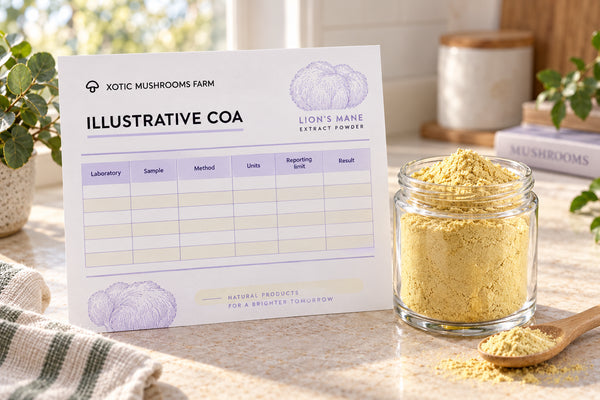
How to Read a Lion's Mane COA (Certificate of Analysis)Learn how to read a Lion's Mane COA section by section: lab accreditation, batch ID, test methods, units,...
 7 October 2026
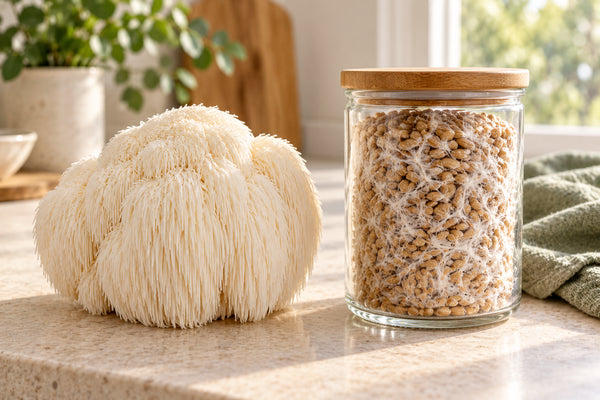
Fruiting Body vs Mycelium on Grain: What to Ask a Lion's Mane SupplierLion's Mane fruiting body vs mycelium on grain: a neutral look at how each is made, what testing...
Get farm and supply updates
New batches, lab results and bulk pricing, a few times a year.
More from White Label & Bulk Supply
- How White Label Lion's Mane Supply Works: From Sample to First Order
- Packaging Considerations for Lion’s Mane Extract
- Shelf Stability of Lion’s Mane Extract Powder
- Custom Formulation Options for Lion’s Mane Products
- Importing and Sourcing Lion’s Mane Extract in Australia
- COAs and Testing for Lion’s Mane Extract Products