
Using Lion’s Mane Extract Powder in Functional Foods

Food is harder on an ingredient than a capsule is. Heat, water, fat, protein and a production line all get a say, and an ingredient that looks fine on a spec sheet can still clump, sink or taste wrong once it is in a bar or a drink.
Lion’s Mane extract powder has earned a place in functional foods because it is easier to work with than many other mushrooms. We grow and extract ours on our farm in Thomastown, Victoria, and this is how we would approach putting it into a food product.
Why Does Lion’s Mane Extract Powder Suit Functional Foods?
It suits food because it mixes evenly, tastes mild and works at small serves. Our Lion’s Mane extract powder is a single ingredient: 100% fruiting body, 10:1 extract, no added starch, grain, mycelium or fillers. That simplicity is useful when you are building a recipe around it.
1. How It Disperses in Food
Uneven mixing means uneven serves, gritty texture and batch-to-batch differences. Extract powder generally disperses more evenly than whole mushroom powder because the extraction step leaves behind much of the coarse, fibrous material. That makes it easier to blend into liquids, soft foods and dry mixes.
In drinks and powdered mixes, better dispersion helps each batch look and pour the same. You also tend to see less sediment than with ground whole mushroom. Fewer surprises at scale-up, fewer tweaks to the method.
Still, test it in your own base. Fat, protein and pH all change how a powder behaves.
2. A Mild Flavour
Flavour is where many mushroom products fall over. Some mushrooms bring strong bitterness or a lingering earthy note that needs heavy masking. Lion’s Mane is milder, so it is easier to add without taking over the product.
That means your flavour team spends its time building flavour, not covering it up. Less masking can mean fewer sweeteners and flavourings on the ingredients list, which keeps the label shorter. For a product people buy every week, a familiar taste is what brings them back.
3. Small Serves
Big inclusion rates hurt texture, taste and colour. Because extract powder is more concentrated than plain mushroom powder, you can work with smaller amounts. Our own retail serve is 1 g of powder.
A small inclusion is easier to hide in drinks, bars and plant-based dairy, where there is little room for change in taste or mouthfeel. It is also easier to measure accurately on a production line.
One note on the ratio. 10:1 tells you how much raw mushroom went in, about 4 kg of fresh Lion’s Mane per 100 g of extract. It is not a measure of strength.
4. Processing and Shelf Life
Mixing, heating and drying put stress on any ingredient. We freeze-dry our fruiting bodies at minus 82 °C and extract with hot water and ethanol, so the powder starts dry and stable. How it holds up in your process depends on your temperatures, times and moisture, so run a pilot batch.
Shelf life is the same story. Check flavour, colour and separation over time in the finished product, and keep the extract itself sealed, cool and dry before use. That work up front saves recalls and relabels later.
Which Functional Food Formats Work Best with Lion’s Mane?

Drinks and dry mixes are the easiest starting point. Here is how we see the main formats:
1. Drinks and Drink Mixes
Coffee, tea, smoothies, functional waters and powdered mixes all suit Lion’s Mane. The mild taste and small serve keep the drink tasting like itself. Give powdered mixes a good shake or whisk, and check for settling in ready-to-drink formats.
2. Bars, Bites and Snacks
In bars, texture and binding are everything. Extract powder is less fibrous than ground whole mushroom, so it is less likely to add grit or dryness. A fixed amount per bar keeps each piece consistent.
3. Yoghurt and Plant-Based Dairy
Yoghurt, fermented products and dairy alternatives need ingredients that leave texture and cultures alone. At a modest inclusion, the powder can usually go in without much change to thickness or mouthfeel. Trial it through a full fermentation before you commit.
4. Baked and Shelf-Stable Foods
Baking is the toughest test because of the heat. Plenty of brands do it, but bake trial batches and check flavour and colour in the finished product. If heat is a concern, adding the powder to a filling, coating or topping is an option.
What Should Food Manufacturers Check When Formulating?
Treat it as a new ingredient to trial, not a straight swap. Three things to check:
- Inclusion level and sensory limits: Run a small series of inclusion levels and taste them blind. Start low and find the point where the product still tastes and feels right.
- Interaction with other ingredients: Proteins, fibres, sweeteners and emulsifiers can all change thickness, solubility or flavour release. Test the full recipe, not the extract in water.
- Flow and handling: In dry blending and filling, flow matters. Keep the powder sealed and dry until use to avoid clumping and dosing errors, and ask for a sample to run through your own equipment.
What About Regulation and Labelling?

Foods and supplements are regulated differently, so decide early which one you are making. Ingredient naming, food category and permitted claims need to line up from the start, or you risk a reformulation or a relabel late in development.
Our Lion’s Mane is sold as a food in Australia. Australian rules do not allow foods to make health or therapeutic claims, so our own labels describe what it is, how it is made and how it is tested. If you sell in other markets, check the rules there with your regulatory adviser.
What helps at review time is paperwork: a spec sheet, a clear process description and dated lab reports. We can supply our spec sheet and our testing record, where each result names the lab, the sample and the date. That keeps labels accurate across production runs and markets.
Good documentation also makes retailers more comfortable ranging your product, and lowers the chance of problems after launch.
What Mistakes Do Brands Make with Lion’s Mane in Food?
Most failures come from assumptions nobody tested. The three we see most:
- Using whole mushroom powder instead of extract: Ground whole mushroom brings more fibre, texture and flavour to manage. Extract is easier to control in food.
- Putting too much in: An overloaded recipe tastes like a supplement. The product should eat well first.
- Formulating food like a capsule: A capsule only has to hold powder. A food has to taste, pour, bake and keep. Test accordingly.
Premium vs Commodity Lion’s Mane Extract in Food

Two extracts can look the same on paper and behave quite differently in production. This is the general pattern buyers report between the two ends of the market:
| Aspect | Commodity Lion’s Mane Extracts | Premium Lion’s Mane Extracts |
|---|---|---|
| Specification Fit | Often meets basic specs on paper | Meets specs with tighter internal tolerances |
| Behaviour in Food Matrices | Variable performance once incorporated into foods | Predictable behaviour across different food systems |
| Taste and Sensory Impact | Greater risk of flavour drift or off-notes between batches | Stable, consistent sensory profile batch to batch |
| Solubility and Dispersion | Inconsistent dispersion, higher risk of separation or sediment | Reliable dispersion with uniform distribution |
| Processing Stability | More sensitive to heat, moisture, and processing stress | Better tolerance through processing and storage |
| Impact on Manufacturing | Increased rework, reformulation, and quality intervention | Reduced waste, fewer adjustments during scale-up |
| Shelf-Life Performance | Higher risk of variability over time | More stable shelf-life and performance consistency |
| Suitability for Scale | Adequate for short runs or low volumes | Designed for long-term, high-volume food manufacturing |
What This Means for Brands, Manufacturers and Co-Packers
Customers come back when the product tastes and feels the same every time. That matters more than a clever launch.
For a brand, one consistent source makes it easier to add new products later. Our powder and capsule lines use the same 10:1 extract from the same farm, so the origin story and lab reports carry across. For a co-packer, a predictable ingredient means fewer stoppages and fewer quality holds.
Before you commit, ask any supplier for:
- A sample to trial in your own recipe.
- The spec sheet, including the part of the mushroom used and what it is grown on.
- Dated lab reports, and which sample each one covers.
- MOQ and lead time for your volume.
Building Your Functional Food with Xotic
The best functional ingredient is one you stop thinking about once the recipe is locked. We supply our 10:1 fruiting body extract in 1 kg and 5 kg bulk bags for formulators, and as white or private label powder for brands.
Developing a drink, snack or shelf-stable food? Ask us for a sample and the spec sheet. We will confirm MOQ and lead time when you enquire.
Source Lion’s Mane extract powder at scale
Australian-grown 10:1 fruiting body extract in 1 kg and 5 kg bags, with named-lab testing and white label supply for growing brands.
Request a sample or quote
Related articles
 17 October 2026
What Is the ARTG? A Plain Guide for Supplement BrandsWhat is ARTG? A plain-English guide for supplement brands to the Australian Register of Therapeutic Goods, AUST L...
 7 October 2026
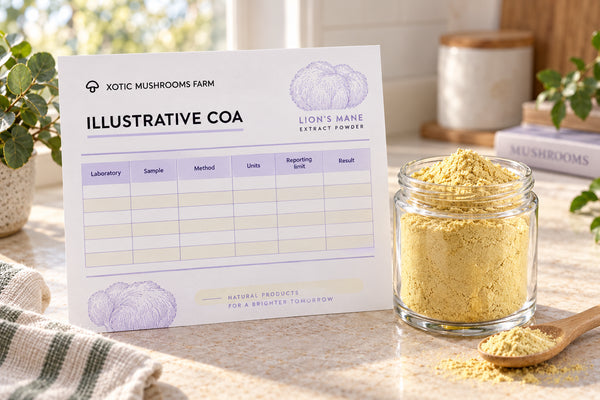
How to Read a Lion's Mane COA (Certificate of Analysis)Learn how to read a Lion's Mane COA section by section: lab accreditation, batch ID, test methods, units,...
 7 October 2026
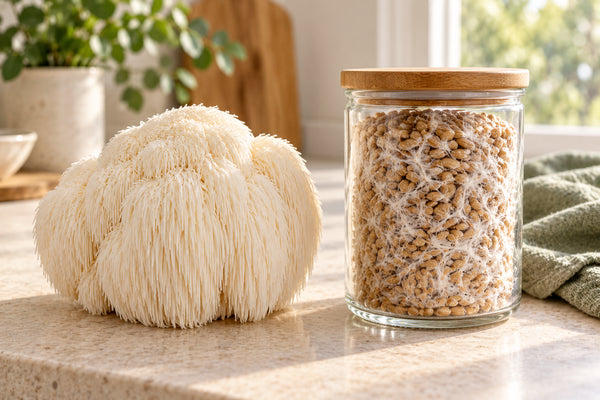
Fruiting Body vs Mycelium on Grain: What to Ask a Lion's Mane SupplierLion's Mane fruiting body vs mycelium on grain: a neutral look at how each is made, what testing...
Get farm and supply updates
New batches, lab results and bulk pricing, a few times a year.
More from White Label & Bulk Supply
- Lion’s Mane Product Development Insights for Brands
- Quality Standards We Follow for Lion’s Mane Products
- Educational Resources for Lion’s Mane Supplement Brands
- Our Approach to White Label Lion’s Mane Manufacturing
- Choosing a Reliable White Label Lion’s Mane Supplier
- From Farm to Extract Lion’s Mane Production Explained