Lion’s Mane Extract Powder for Ready-to-Mix Products

Ready-to-mix products succeed or fail based on how they perform in the consumer’s glass, not how they look on a formulation sheet. Clumping, uneven dispersion, off-notes, and inconsistent texture are quickly noticed and rarely forgiven.
Ingredients that work well in capsules or beverages can behave very differently once dry-blended and reconstituted by hand. Lion’s Mane extract powder has become a preferred ingredient in RTM formulations because it disperses more predictably, integrates cleanly with common mix components, and maintains consistency from blending through shelf life.
For manufacturers, these characteristics make it a practical choice for scalable RTM production.
What are Ready-to-Mix Products?
Ready-to-mix (RTM) products are dry formulations designed to be combined with a liquid by the consumer immediately before use. They are engineered to dissolve or disperse quickly with minimal effort, delivering a consistent taste, texture, and functional profile once mixed.
RTM products are commonly packaged as powders in sachets, stick packs, tubs, or pouches and are intended to be mixed with water, milk, or plant-based liquids using a spoon or shaker. Typical examples include functional drink mixes, hydration blends, protein powders, meal replacements, and wellness formulations.
From a manufacturing perspective, RTM products must prioritise flowability, uniform blending, fast reconstitution, and sensory stability, as performance is judged instantly at the point of mixing. Unlike beverages or capsules, RTMs succeed only when they mix smoothly and perform reliably under real-world consumer conditions.
Why Lion’s Mane Extract Powder Works in Ready-to-Mix Products

In ready-to-mix products, ingredient performance is revealed the moment water is added. Below is why Lion’s Mane extract powder consistently delivers smooth mixing, clean taste, and reliable performance in RTM formulations:
1. Fast Dispersion and Reconstitution
In RTM products, the moment of truth happens when the consumer adds liquid. Powders that clump, float, or settle unevenly create a poor first impression. Lion’s Mane extract powder disperses more evenly than whole mushroom powder because insoluble fibrous material has largely been removed during processing.
When mixed with water, milk, or plant-based liquids, extract powder hydrates more consistently, reducing clumps and visible residue. This supports a smoother mouthfeel and more uniform functional delivery. For manufacturers, improved reconstitution reduces the need for aggressive emulsifiers or excessive agitation instructions, making products easier to use in real-world conditions.
2. Neutral Sensory Profile for Mixes
Taste and mouthfeel are critical in RTM formats, where flavours are often lightly sweetened or intentionally subtle. Many medicinal mushrooms introduce bitterness or earthy notes that linger once rehydrated. Lion’s Mane extract powder has a relatively mild sensory profile, making it easier to integrate without dominating the flavour system.
This neutrality allows flavour developers to work within tighter tolerances, reducing the need for masking agents or excessive sweeteners. It also supports cleaner finishes, which are particularly important in daily-use RTM products such as nootropic drinks, wellness blends, and functional hydration mixes.
3. Lower Inclusion Rates for Better Mixability
RTM products are sensitive to powder load. Higher inclusion rates increase the risk of clumping, chalkiness, and uneven dispersion. Because Lion’s Mane extract powder is more concentrated than whole mushroom powder, functional positioning can be achieved at lower inclusion levels.
Lower dosing improves mixability and mouthfeel while simplifying blending and packaging. It also reduces variability during scooping or sachet filling, supporting more consistent consumer experience across servings.
4. Compatibility With Common RTM Ingredients
RTM products often contain proteins, electrolytes, fibres, sweeteners, flavours, and functional additives. Lion’s Mane extract powder generally integrates well with these components, particularly when particle size and moisture are controlled.
Its compatibility reduces the risk of separation, flavour distortion, or texture changes after reconstitution. This makes it easier to build complex RTM formulas without constant reformulation as ingredients are adjusted.
Ready-to-Mix Formats Where Lion’s Mane Performs Best

Different RTM formats place different demands on ingredients. Lion’s Mane extract powder performs particularly well in formats that rely on fast hydration and clean mouthfeel:
1. Sachets and Single-Serve Sticks
Single-serve sachets require precise dosing and fast reconstitution. Lion’s Mane extract powder supports uniform blending and consistent performance across units, reducing the risk of variability between sachets.
2. Tub-Based Drink Mixes
In tubs, flow and scoop consistency matter. Extract powder with controlled particle size and moisture content helps maintain even distribution throughout the container, reducing serving-to-serving variation.
3. Meal Replacement and Functional Blends
Meal replacements and multi-functional blends require ingredients that do not interfere with texture or flavour balance. Lion’s Mane extract powder integrates without significantly altering viscosity or mouthfeel when used appropriately.
Key Formulation Considerations for RTM Manufacturers
Before scaling any ready-to-mix product, formulation choices determine whether powders blend smoothly or become a source of clumping, inconsistency, and rework. Below are the key considerations RTM manufacturers must account for when working with Lion’s Mane extract powder:
- Flow Properties and Anti-Caking: Powder flow affects blending, filling, and consumer scooping. Lion’s Mane extract powder with controlled moisture and particle size reduces clumping and supports consistent flow. Anti-caking agents may still be required, but their use can often be minimised.
- Mixing Behaviour in Cold vs Warm Liquids: Consumers reconstitute RTM products in a variety of liquids and temperatures. Extract powder performs more consistently across cold and warm liquids than whole mushroom powder, but testing across use cases remains essential.
- Sensory Thresholds and Consumer Experience: Even neutral ingredients have sensory limits. Inclusion levels should be tested to avoid chalkiness, residue, or aftertaste, particularly in lightly flavoured products.
Processing and Manufacturing Considerations

Once a ready-to-mix product moves from bench testing to production, processing decisions directly affect flow, blend uniformity, and consumer experience. Below are the core manufacturing considerations that determine whether Lion’s Mane extract performs consistently at scale:
- Powder flow properties: Ensure consistent flow during blending, filling, and sachet packing to prevent segregation and weight variation.
- Particle size compatibility: Match Lion’s Mane extract particle size with other ingredients to support uniform mixing and avoid settling.
- Moisture control: Maintain low moisture environments to prevent clumping, caking, and reduced shelf stability.
- Blending sequence: Introduce extract at the correct stage to promote even distribution without over-shearing.
- Equipment suitability: Use mixers and fillers designed for fine functional powders to minimise loss and variability.
- Batch consistency checks: Monitor blend uniformity across runs to ensure repeatable performance.
- Packaging Compatibility: RTM products are sensitive to moisture ingress. Packaging must protect against humidity to prevent clumping and loss of flow. Extract powder with stable moisture characteristics supports longer shelf life.
- Shelf-Life Stability: Over time, powders can absorb moisture, compact, or lose reconstitution performance. Premium extract powders maintain stability more effectively, reducing quality complaints late in shelf life.
Regulatory and Labelling Considerations for Ready-to-Mix Products
RTM products are generally regulated as foods rather than supplements, which affects ingredient naming and claims. Lion’s Mane extract powder is typically positioned as a food ingredient when used within appropriate limits.
Clear documentation, consistent specifications, and traceable sourcing support smoother regulatory review and retailer acceptance. Early alignment between formulation and regulatory strategy reduces the risk of reformulation or relabelling after launch.
Common Mistakes When Using Lion’s Mane in RTM Products

One of the most common mistakes in RTM development is using whole mushroom powder instead of extract. Whole powders contain high levels of insoluble fibre that clump during reconstitution and rehydrate unevenly, resulting in gritty textures and inconsistent mixing.
Another frequent issue is overloading the formula in an attempt to maximise functional positioning. Excessive inclusion rates quickly compromise mixability, mouthfeel, and flavour balance.
RTM products perform best when dosing is precise and restrained. A further oversight is ignoring real consumer mixing behaviour. Formulations are often tested under ideal lab conditions, yet consumers typically mix with spoons, shakers, or minimal agitation.
Failing to account for these realities leads to products that perform well in development but poorly in everyday use.
Building Ready-to-Mix Products That Perform Every Time
Ready-to-mix products are judged in seconds, but built over months of careful formulation and manufacturing control. Xotic Mushrooms supplies ready-to-mix–grade Lion’s Mane extract powder developed for consistent dispersion, clean taste, and scalable production.
If you are developing sachets, drink mixes, or functional blends, partner with Xotic Mushrooms to source Lion’s Mane extract that supports smooth mixing, stable shelf life, and confident growth.
Source Lion's Mane extract powder at scale
Consistent extract quality, full testing, and white label supply built for growing brands.
Talk to our supply teamRelated articles
 20 August 2026
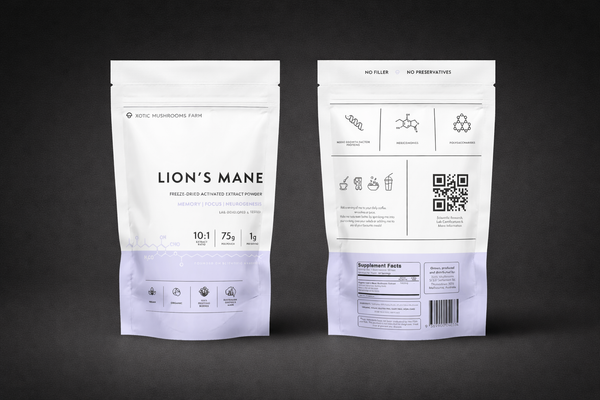
Packaging Considerations for Lion’s Mane ExtractPackaging plays a critical role in maintaining the quality and performance of Lion’s Mane extract. While formulation and...
20 August 2026
Packaging Considerations for Lion’s Mane ExtractPackaging plays a critical role in maintaining the quality and performance of Lion’s Mane extract. While formulation and...
 20 August 2026
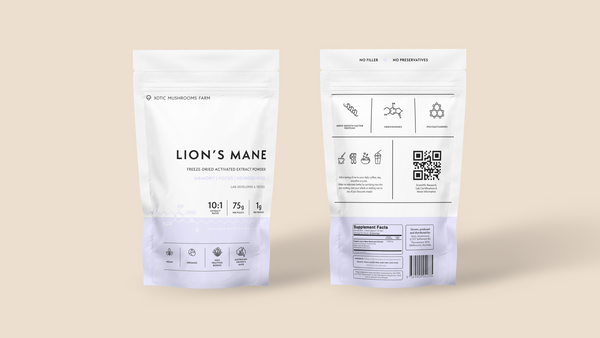
Shelf Stability of Lion’s Mane Extract PowderShelf stability plays a central role in how well a Lion’s Mane extract powder performs over time. For...
20 August 2026
Shelf Stability of Lion’s Mane Extract PowderShelf stability plays a central role in how well a Lion’s Mane extract powder performs over time. For...
 20 August 2026
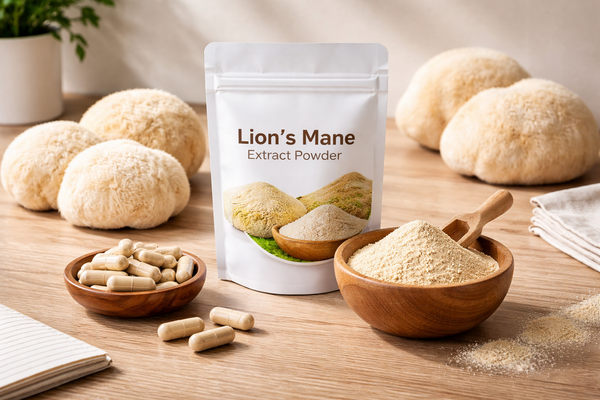
Lion’s Mane Powder for Nootropic Supplement LinesNootropic supplements have become one of the fastest growing segments within the nutraceutical industry. These products are commonly...
20 August 2026
Lion’s Mane Powder for Nootropic Supplement LinesNootropic supplements have become one of the fastest growing segments within the nutraceutical industry. These products are commonly...
Get supply and pricing updates
Product specs, new extract batches, and bulk pricing for supplement brands and distributors.