What Is Lion's Mane Extract? A Buyer's Guide

Introduction
Lion's Mane extract is a concentrated powder made by extracting the Lion's Mane mushroom (Hericium erinaceus) in water, alcohol or both, then drying the result. This guide explains how it is made, what ratios such as 10:1 really tell you, why fruiting body matters, how extract differs from whole powder, what it is traditionally used and researched for, how to read a label and lab results, and where it sits legally in Australia. It is written for brands, formulators and buyers who want facts before they choose a supplier.
What is Lion's Mane extract?
Lion's Mane extract is the concentrated, dried output of an extraction process applied to Lion's Mane mushroom material, usually sold as a fine powder or filled into capsules. The raw material is Hericium erinaceus, a white, shaggy mushroom that grows on hardwood and has a long history in East Asian cooking and traditional practice.
Unlike a whole-mushroom powder, which is simply dried and milled, an extract has been through a step that pulls compounds out of the mushroom tissue and leaves much of the indigestible fibre behind. The result is a more concentrated, more dispersible ingredient that suits drinks, capsules and blends.
Not every product sold as an extract is made the same way. The starting material (fruiting body or mycelium), the solvent (hot water, ethanol or both), the ratio and whether fillers are added all change what ends up in the pack. That is why serious buyers ask for a specification sheet and laboratory reports rather than relying on a label.
At Xotic Mushrooms our Lion's Mane extract powder is made from 100% Hericium erinaceus fruiting body, grown on our farm in Thomastown, Victoria, with no added starch, grain or mycelium.
How is Lion's Mane extract made?
Lion's Mane extract is made by harvesting the mushroom, drying it, extracting it in a solvent such as hot water and ethanol, then concentrating and drying the liquid into a powder. Each stage affects the finished ingredient, so it pays to know the sequence.
- Grow: the mushroom is cultivated on a substrate. Ours grows on Tasmanian oak hardwood sawdust and Australian soya husk.
- Harvest: mature fruiting bodies are selected and picked, by hand on our farm.
- Dry: the fresh mushroom is dried. We freeze-dry, which removes water at very low temperatures.
- Extract: the dried material is extracted. Ours uses a hot-water and ethanol dual extraction.
- Concentrate and dry: the liquid extract is concentrated and dried back into a fine powder, then packed or encapsulated.
Hot water is generally used to draw out water-soluble polysaccharides, including beta-glucans, while ethanol is used for less water-soluble compounds. A dual extraction combines both. Freeze-drying is a gentler way to remove moisture than high-heat drying, which is one reason it is favoured for delicate fresh mushrooms.
You can see each step on our farm and process page.
What does a 10:1 Lion's Mane extract ratio mean?
A 10:1 ratio means roughly ten parts of dried starting mushroom material went into one part of finished extract. It describes the concentration of the input, not strength or effect, and it is the single most misunderstood number on a mushroom label.
Extract ratios are stated against dried material, not fresh mushroom. Fresh-weight figures are a separate way of describing the same process: because fresh Lion's Mane is mostly water, our specification notes that about 4 kg of fresh mushroom goes into every 100 g of our 10:1 extract powder. That fresh-weight example is useful context, but it is not the ratio itself, and the two numbers should never be compared directly.
Other ratios you will see include 4:1, 8:1, 20:1 and even 30:1. A higher ratio is not automatically better. Two suppliers can both claim 10:1 and deliver very different powders, depending on the starting material, solvent and whether carriers such as maltodextrin are added back in. The ratio also says nothing about how much of any specific compound is present.
| Label term | What it tells you | What it does not tell you |
|---|---|---|
| Extract ratio (for example 10:1) | How much dried raw material went in per unit of extract | Compound content, strength or effect |
| Beta-glucan percentage | A measured amount of one polysaccharide group, by a named method | Results by other test methods, or other batches |
| Total polysaccharides | A broad carbohydrate measure | How much is beta-glucan versus starch or other sugars |
That is why a ratio should always be read alongside a measured result from a named laboratory.
How to read a Lion's Mane extract label
A quick label check tells you most of what you need before you ask for documents. Run through these six points on any Lion's Mane product, including ours.
- Species: the botanical name Hericium erinaceus should be stated, not just "Lion's Mane" or "mushroom blend".
- Part used: fruiting body, mycelium or a blend, and if a blend, in what proportion.
- Extraction method: hot water, ethanol or dual extraction, with the ratio and whether it refers to dried material.
- Carriers or fillers: any maltodextrin, starch, grain or flow agents added to the finished powder.
- Actual extract per serving: the weight of extract in each serve or capsule, as opposed to the "equivalent" weight of raw mushroom.
- Scope of the lab report: which laboratory, which sample, which date, which method, and whether it covers the batch you are buying.
Fruiting body vs mycelium: why does it matter?
Fruiting body extracts are made from the mushroom itself, while mycelium products are made from the root-like network, often grown on grain that can end up in the finished powder. Both are sold as Lion's Mane, so buyers need to know which they are getting.
The fruiting body is the visible mushroom that is traditionally harvested and eaten. Mycelium is the vegetative growth that runs through the substrate. When mycelium is cultivated on grain such as rice or oats, separating the mycelium from the grain is difficult, and the final product may contain a meaningful share of starch from that grain.
This matters commercially because starch can inflate a total polysaccharide figure without adding beta-glucans. Testing methods that report beta-glucans separately help make the comparison fair. Our guide to fruiting body vs mycelium on grain sets out the questions to put to suppliers.
Our extract is fruiting body only, with no mycelium, grain or starch fillers.
Lion's Mane extract vs whole-mushroom powder
Whole-mushroom powder is dried and ground mushroom, while extract powder has been through an extraction step that concentrates certain compounds and improves dispersion. Each has a place, but they are not interchangeable.
| Factor | Extract powder | Whole-mushroom powder |
|---|---|---|
| Processing | Dried, extracted, concentrated, dried again | Dried and milled |
| Fibre (chitin) | Largely reduced | Retained |
| Behaviour in drinks | Generally disperses better | Tends to settle |
| Typical uses | Capsules, drinks, blends, stick packs | Cooking, food applications |
| Raw material per gram | Higher | Lower |
Whole powder carries much of the nutritional profile of the dried mushroom, including protein and fibre. Extract concentrates the compounds released by the solvents into a smaller serve. Our detailed comparison, Lion's Mane extract vs whole-mushroom powder, goes deeper.
What is Lion's Mane traditionally used and researched for?
Lion's Mane has been traditionally used in East Asian cooking and wellness practice, and it is often researched for its potential role in cognitive function and nerve health. The wording matters here, because research interest is not the same as a proven outcome.
Laboratory and animal studies have looked at compounds in Lion's Mane, such as hericenones (found in the fruiting body) and erinacines (found mainly in mycelium), for their possible interaction with nerve growth factor. Human studies exist but are small. For example, Mori et al. (2009, Phytotherapy Research) ran a double-blind, placebo-controlled trial in 30 older Japanese adults with mild cognitive impairment over 16 weeks, and Docherty et al. (2023, Nutrients) ran a 28-day pilot study in 41 healthy young adults. Both were small, used specific preparations and doses, and cannot be generalised to every Lion's Mane product.
For brands, the responsible position is that Lion's Mane may support cognitive wellbeing as part of a balanced diet and is often researched for brain and nerve health. It is not a treatment for any condition, and claims on a finished product must meet the rules in your market.
How do you judge Lion's Mane extract quality and lab results?
Judge Lion's Mane extract quality by checking the starting material, extraction method, named laboratory results, the test method used and whether results cover your batch. A credible supplier will show you all five.
- Part used: fruiting body, mycelium or a blend.
- Extraction: hot water, ethanol or dual, and the stated ratio.
- Beta-glucans: a measured figure, with the method named (for example the Megazyme mushroom and yeast method).
- Contaminants: heavy metals and microbial screening from an independent laboratory.
- Scope: the sample, date and whether results apply to every batch.
Be wary of results without a lab name, a date or a method. Our specifications and testing page lists independent results from laboratories including Symbio and the National Measurement Institute, each with a sample and date, and we are clear that results apply to the named sample rather than certifying every batch.
Our guide, Lion's Mane extract specifications explained, walks through each line of a spec sheet.
Is Lion's Mane extract legal in Australia?
Lion's Mane is widely sold in Australia as a food ingredient and in listed complementary medicines, but how a product is regulated depends on its form, ingredients and the claims made about it. This section is general context, not legal advice.
In Australia, foods are governed by the Food Standards Code administered by Food Standards Australia New Zealand, which includes rules on novel foods. Products presented as medicines, or making therapeutic claims, fall under the Therapeutic Goods Administration. A capsule making health claims and a culinary powder sold as food can sit in different categories.
Brands should confirm the right pathway for their own product, ingredient form and claims with a regulatory adviser. Your supplier can support that work with specifications and laboratory reports, but responsibility for label claims sits with the brand selling the product.
Conclusion
Lion's Mane extract is a concentrated, more dispersible form of Hericium erinaceus, and its value depends on the starting material, extraction method and verifiable testing. If you are weighing an extract for your own range, request a sample and our specification sheet and we will share the reports that apply.
FAQs
What does Lion's Mane extract do?
Lion's Mane extract is a concentrated form of the Lion's Mane mushroom that is traditionally used in East Asian wellness practice and often researched for cognitive function and nerve health. Evidence in humans is still limited, so it is best described as something that may support cognitive wellbeing as part of a balanced diet, rather than a product with a guaranteed effect.
What is the downside of Lion's Mane extract?
The main downsides are quality variation and limited human research. Products differ widely in starting material, ratio and fillers, and some people report mild digestive discomfort. People with mushroom allergies should avoid it, and anyone pregnant, breastfeeding or taking medication should speak with a health professional before use.
Does Lion's Mane extract give you a high?
No. Lion's Mane is a culinary and functional mushroom. It does not contain psilocybin and does not produce a psychedelic high. It is eaten as a food in many countries and sold in Australia as a food ingredient and in complementary products.
Is Lion's Mane extract legal in Australia?
Yes, Lion's Mane products are legally sold in Australia. How a specific product is regulated depends on its form and claims: foods fall under the Food Standards Code, while products with therapeutic claims fall under the TGA. Brands should confirm the right pathway for their product with a regulatory adviser.
What does 10:1 mean on Lion's Mane extract?
A 10:1 ratio means about ten parts of dried starting mushroom material went into one part of finished extract. It describes how concentrated the input was, not how strong the product is. To judge content, look for a measured beta-glucan result from a named laboratory and test method.
Is fruiting body Lion's Mane extract better than mycelium?
Fruiting body extract is made from the mushroom itself, while mycelium products are often grown on grain that can carry starch into the final powder. Many buyers prefer fruiting body for that reason, but the fairest comparison uses lab results that report beta-glucans separately from total polysaccharides.
Source Lion’s Mane extract powder at scale
Australian-grown 10:1 fruiting body extract in 1 kg and 5 kg bags, with named-lab testing and white label supply for growing brands.
Request a sample or quote
Related articles
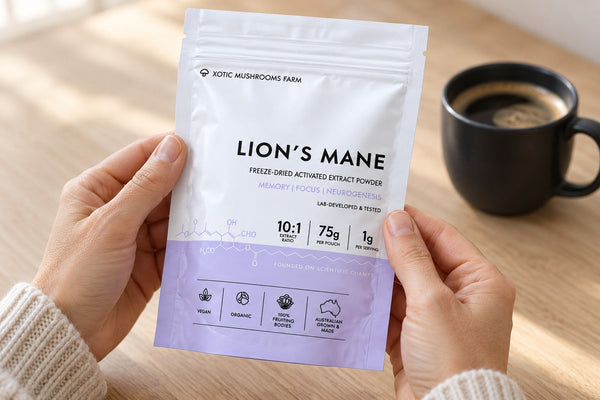 7 October 2026
Best Mushroom Coffee in Australia: What to Look For on the LabelLooking for the best mushroom coffee in Australia? Use this label checklist to compare mushroom type, extract ratio,...
7 October 2026
Best Mushroom Coffee in Australia: What to Look For on the LabelLooking for the best mushroom coffee in Australia? Use this label checklist to compare mushroom type, extract ratio,...
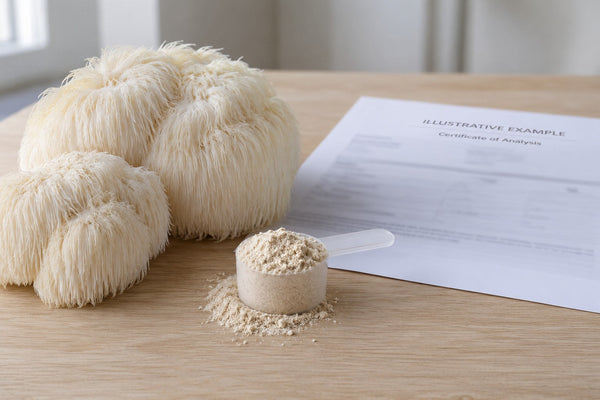 7 October 2026
Mushroom Extract in Australia: What Buyers Should CheckBuying mushroom extract in Australia? Learn how to check the extract ratio, fruiting body source, beta-glucans, extraction method,...
7 October 2026
Mushroom Extract in Australia: What Buyers Should CheckBuying mushroom extract in Australia? Learn how to check the extract ratio, fruiting body source, beta-glucans, extraction method,...
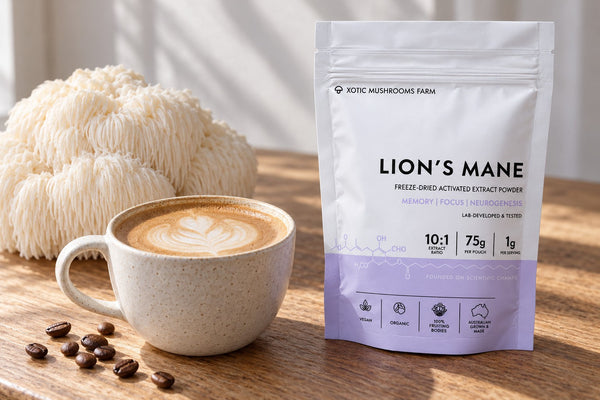 7 October 2026
Mushroom Coffee in Australia: What It Is and How to ChooseA clear guide to mushroom coffee in Australia: what it is, which mushrooms are used, what to check...
7 October 2026
Mushroom Coffee in Australia: What It Is and How to ChooseA clear guide to mushroom coffee in Australia: what it is, which mushrooms are used, what to check...
Get farm and supply updates
New batches, lab results and bulk pricing, a few times a year.